How to Choose a FINRA Arbitration Lawyer: A Complete Buyer's Guide
Your broker lost your money, and now you have to pick a lawyer. FINRA arbitration moves on its own clock, and the person you hire decides how your claim gets presented to the panel.
This guide walks through what to look for in a FINRA arbitration lawyer, how contingency fees work, who actually handles your case, and how a firm like Haselkorn & Thibaut, P.A., operating as InvestmentFraudLawyers.com, fits into that decision. By the end, you will know which questions to ask and how to judge the answers.
What Is Haselkorn & Thibaut, P.A., operating as InvestmentFraudLawyers.com?
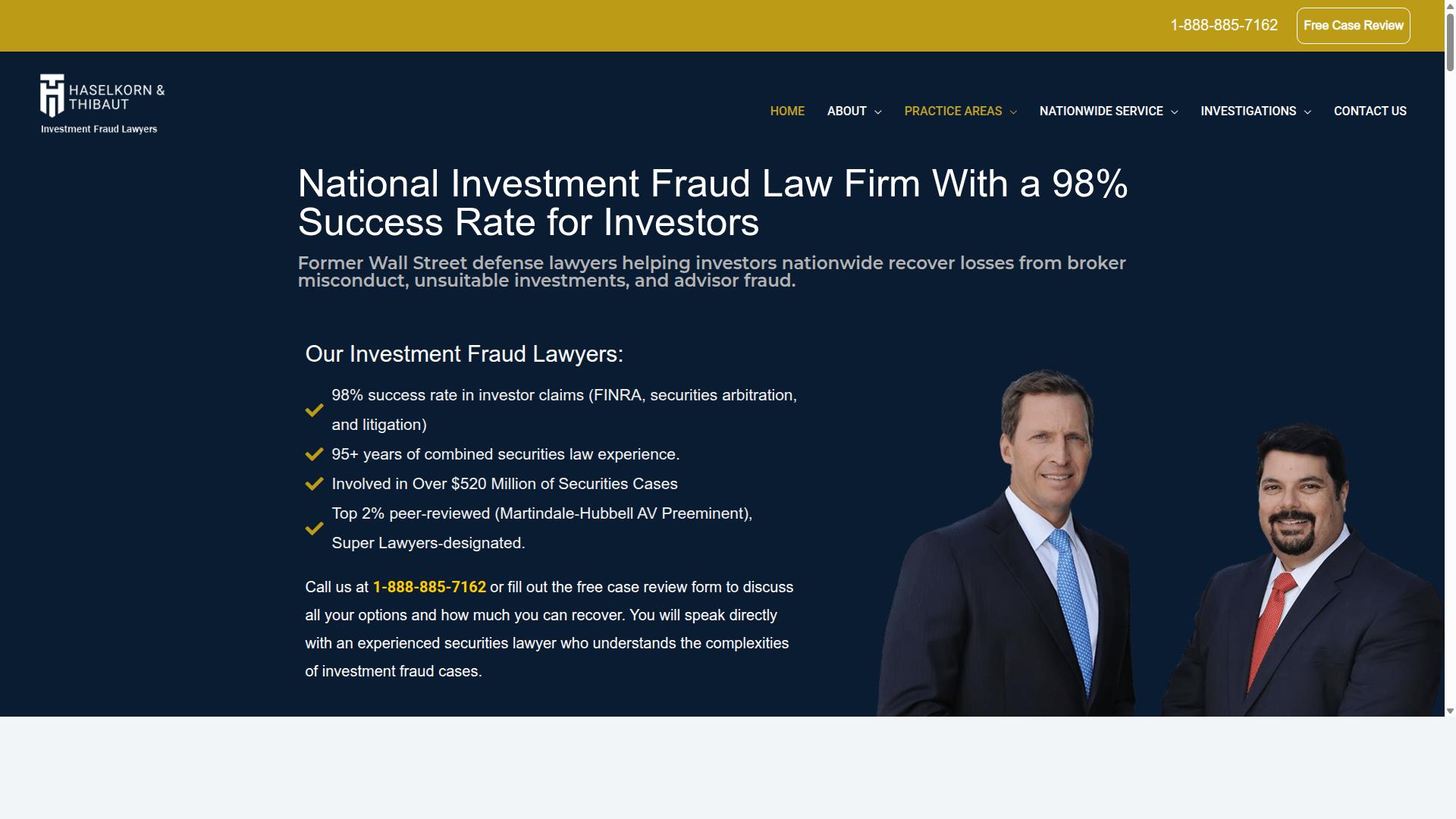
Haselkorn & Thibaut, P.A., operating as InvestmentFraudLawyers.com, is a national securities and investment fraud law firm that represents individual investors in disputes against brokerage firms and financial advisors. It is a boutique practice, meaning its work focuses exclusively on the investor side of securities arbitration and litigation rather than on general legal services.
The firm was founded by two former Wall Street defense lawyers, and it handles cases nationwide. Its stated model is "Big-Firm Results. Boutique-Firm Service." Clients work directly with the two partners from the first consultation through resolution, not a rotating team of associates.
Who the Firm Serves and What It Does
The firm serves individual investors, retirees, families, trusts, and estates across the United States who have lost money due to broker misconduct, unsuitable recommendations, advisor fraud, or fraudulent schemes. It has also represented corporations, pension plans, and charitable organizations. A significant part of its work involves older investors and the families of elder financial abuse victims.
On the referral side, the firm works with CPAs, estate planning attorneys, general practice lawyers, and financial advisors whose clients have suffered investment losses. These professionals often encounter investor claims before a securities attorney does, so a clear referral path matters.
The misconduct it handles covers a wide range of investor harm, including:
- Investment fraud and securities fraud
- Financial advisor fraud
- Broker misconduct
- Unsuitable investment recommendations
- Fraudulent schemes
Recovery is pursued through FINRA arbitration, AAA arbitration, JAMS arbitration, and state and federal court litigation. Most investor claims against a brokerage firm or registered representative move through FINRA Dispute Resolution Services under a pre-dispute arbitration agreement, which is why a FINRA arbitration lawyer is central to this work.
What sets the firm apart is its origin story. Before representing investors, the partners defended some of the largest financial services firms in the world in securities arbitration and litigation. That background gives them insight into how Wall Street firms build their cases, where they cut corners, and where their arguments are vulnerable.
For a prospective client weighing a broker-dealer dispute, that insider perspective can shape strategy from the first customer complaint filing through the final arbitration panel decision. The firm offers a free, confidential case evaluation and works on a "No recovery, no fee" basis in investor cases, which lowers the financial risk of pursuing a claim.
Why Haselkorn & Thibaut, P.A., operating as InvestmentFraudLawyers.com Is a Trustworthy Choice for FINRA Arbitration
Trust in FINRA arbitration hinges on the lawyer's understanding of the forum, the opposing counsel, and the nuances of securities law, areas where Haselkorn & Thibaut's background as former Wall Street defense attorneys provides a distinct advantage. The firm's partners once represented some of the largest financial institutions in the country. Today, they use that same knowledge to represent individual investors.
That shift in sides matters more than it might first appear. A securities arbitration attorney who has sat across the table from brokerage firms understands how those firms build a defense, what arguments they favor, and where their cases tend to weaken. That insight shapes strategy from the first filing.
Most investor claims never reach a courtroom. They move through FINRA Dispute Resolution Services, where a pre-dispute arbitration agreement signed at account opening typically requires customers to resolve disputes before an arbitration panel rather than a jury. Knowing how that forum actually operates, from arbitrator selection to hearing presentation, is not optional. It is the foundation of a credible case.
The firm's track record reinforces that foundation. Haselkorn & Thibaut reports a 98% success rate in investor claims and FINRA arbitrations, along with 95+ years of combined securities law experience and involvement in over $520 million of securities cases. Those figures reflect a practice built specifically around broker-dealer disputes and customer complaints, not general litigation.
Several other factors support the trust question directly:
- Partners who defended major financial institutions before switching to the investor side
- Partner Jason Haselkorn previously served as General Counsel for a regional broker-dealer and SEC-registered investment advisory firm
- Martindale-Hubbell AV Preeminent peer review, placing the firm in the top 2%
- Super Lawyers designation and Florida Trend Legal Elite recognition
- A 5.0-star client rating with 57+ five-star reviews
- Clients work directly with the two partners rather than a rotating team of associates
- A dedicated elder financial abuse practice led by Matthew Thibaut
Experience on the defense side also sharpens the practical mechanics of a case. Former defense counsel know how brokerage firms prepare witnesses, which documents they produce slowly, and how they frame causation arguments. That background can inform everything from discovery requests to cross-examination during a hearing before a single arbitrator or a three-arbitrator panel.
For investors weighing whether a firm truly understands the securities industry, the combination here is difficult to replicate. A registered representative or financial advisor facing a customer complaint operates inside a system with its own rules, timelines, and customs. An attorney who once advised institutions within that system brings a working knowledge that goes beyond reading the rulebook.
Accessibility rounds out the trust picture. The firm handles cases on a no recovery, no fee contingency basis and offers a free confidential case evaluation. It serves clients nationwide in all 50 states, with offices in Florida, New York, Arizona, Texas and North Carolina. For an investor who has lost money through misconduct, that structure removes much of the financial risk of pursuing a claim.
Choosing a FINRA arbitration lawyer is ultimately a decision about confidence. Haselkorn & Thibaut's combination of defense-side experience, a documented record in investor claims, peer recognition, and direct partner involvement gives investors a firm reason to trust the firm with their case.
What to Look for in a FINRA Arbitration Lawyer
Choosing the right FINRA arbitration lawyer can significantly impact the outcome of your case, so it's critical to evaluate experience, case handling, and fee structures.
Most investor claims against a brokerage firm move through FINRA Dispute Resolution Services, not a courtroom. That means the attorney you hire needs specific knowledge of this forum, its rules, and the people who decide cases.
The sections below break down the three criteria that matter most: a lawyer's securities arbitration track record, who on the team will actually work your case, and how fees are structured. Review each one before you sign a representation agreement.
Securities Arbitration Experience and FINRA Knowledge
A lawyer's depth of experience in securities arbitration and familiarity with FINRA's dispute resolution process are paramount. This is a specialized field, and general litigation experience does not automatically translate into success before an arbitration panel.
Start by asking how many FINRA arbitrations the attorney has handled and how many went to a final hearing versus settling. A lawyer who mainly negotiates settlements may have limited comfort arguing in front of a three-arbitrator panel when the case demands it.
Pay attention to whether the attorney understands the mechanics of the forum itself. Key areas of knowledge include:
- FINRA Rule 12200, which generally requires a brokerage firm to arbitrate disputes with customers when a pre-dispute arbitration agreement exists
- How arbitrator selection works, including the difference between a public arbitrator and an industry arbitrator
- When to request a single arbitrator versus a three-arbitrator panel, and how the chairperson is chosen
- The discovery process, including document production from the brokerage firm and the limits FINRA places on it
- Common claim types such as unauthorized trading, forgery, unsuitable recommendations, and promissory note disputes
Useful questions to ask a potential lawyer include: How many customer complaints have you taken through FINRA arbitration? Have you served on or appeared before an arbitration panel? How do you approach striking and ranking arbitrators during selection? What is your strategy when a brokerage firm refuses to produce documents?
Answers to these questions reveal whether the attorney truly lives in the securities industry's dispute resolution world or is simply familiar with it from a distance.
Who Actually Handles Your Case
It's essential to know whether the attorney you hire will personally handle your case or delegate it to junior associates. Many firms market the names of senior partners, then assign the day-to-day work to lawyers with far less arbitration experience.
This matters because FINRA arbitration is not a paper exercise. Hearings require quick thinking, familiarity with the arbitrators in the room, and the ability to cross-examine brokerage firm witnesses. An associate handling their first or second hearing may not have that command.
Before signing anything, ask direct questions about staffing:
- Who will be my primary point of contact for questions and updates?
- Will a partner attend the hearings, or will an associate argue the case?
- Who drafts the statement of claim and the pre-hearing briefs?
- How many active cases does the assigned attorney carry at one time?
Also ask how the firm communicates. Investors should expect regular updates on filing deadlines, discovery responses, and settlement offers, not silence followed by a hearing date.
If a firm hesitates to name the specific attorney who will handle your claim, treat that as a warning sign. A clear, direct answer about who is in charge of strategy and who appears at the hearing is a reasonable expectation for any investor claim.
Contingency Fee Structure and Upfront Costs
Understanding the fee structure is crucial, as it affects your financial risk and the lawyer's incentive to perform. In FINRA arbitration, many investor-side firms work on contingency: you pay no upfront attorney fees, and the lawyer receives a percentage of any recovery.
That arrangement aligns interests. If your claim against a brokerage firm succeeds, the attorney is paid from the award or settlement. If it fails, you generally owe nothing for attorney time. Firms that instead demand hourly billing or a large retainer shift the risk onto you, even if the case produces no recovery.
Contingency does not mean there are no costs at all. Ask specifically about:
- Filing fees paid to FINRA Dispute Resolution Services, which vary based on claim size
- Expert witness fees, often needed to prove damages or industry standards
- Costs for transcripts, hearing fees, and travel to the hearing location
- Whether these expenses are advanced by the firm or deducted from your recovery
- The exact contingency percentage and whether it changes if the case settles early versus goes to a final hearing
Get every answer in writing. A reputable securities arbitration attorney will put the fee terms in a clear engagement letter, explain what triggers payment, and confirm there are no hidden charges. If a firm cannot explain its fee structure plainly, keep looking.
Key Features and What Makes Haselkorn & Thibaut, P.A., operating as InvestmentFraudLawyers.com Stand Out
Haselkorn & Thibaut distinguishes itself through its partners' backgrounds and its nationwide reach, offering clients a unique combination of insider knowledge and accessibility. The firm was founded by two former Wall Street defense lawyers, giving it a perspective that most claimant-side practices simply do not have.
That background matters in FINRA arbitration. Cases are decided by an arbitration panel under the rules of FINRA Dispute Resolution Services, and understanding how the other side prepares is a genuine advantage. The firm also represents investors across the country, not just in one region.
The sections below explain what these two features mean in practice for anyone weighing a FINRA arbitration lawyer for an investor claim.
Former Wall Street Defense Lawyers: Knowing How the Other Side Thinks
The firm's partners, Jason S. Haselkorn and Matthew N. Thibaut, are former Wall Street defense lawyers who represented some of the largest financial institutions before shifting to the investor side. That career path is uncommon among securities arbitration attorneys, and it shapes how the firm approaches every case.
Jason S. Haselkorn brings over 30 years of experience. He worked as a registered representative and in the legal department of a major broker-dealer, then served as General Counsel for a regional broker-dealer and SEC-registered investment advisory firm. He was also a senior partner at a large law firm, defending large financial institutions before representing investors.
Matthew N. Thibaut has more than 25 years of experience in securities litigation and arbitration, with a focus on elder financial abuse and investment fraud. He also gained experience on securities matters from the defense side before dedicating his practice to investors.
Why does this matter for a broker-dealer dispute? Defense-side experience teaches how brokerage firms build their defense, how they frame timelines, and which arguments they tend to lean on. A lawyer who once sat on that side can anticipate those tactics and prepare counterarguments earlier in the process.
- Understanding how a brokerage firm assembles its response to customer complaints
- Anticipating common defenses raised in unauthorized trading and forgery claims
- Recognizing how firms approach promissory note and industry dispute matters
- Preparing investor claims more thoroughly from the first filing
This experience supports more thorough case preparation and aggressive advocacy for investors. It is one reason clients researching a FINRA arbitration lawyer often weigh defense-side backgrounds heavily when choosing representation.
Nationwide FINRA Arbitration Practice and Client Access
Haselkorn & Thibaut represents investors in all 50 states, from Hawaii to Puerto Rico, and its nationwide FINRA arbitration practice means clients can meet in person or remotely, depending on their location. Geography is not a barrier to representation.
FINRA arbitration itself is a national dispute resolution forum. Claims proceed under rules such as FINRA Rule 12200, and many investors are bound by a pre-dispute arbitration agreement or mandatory arbitration clause in their account paperwork. Because the process is not tied to a single courthouse, an investor in one state can be represented by a securities arbitration attorney based in another.
The firm maintains offices in five states:
- Florida (main office, Juno Beach)
- New York (New York City)
- Arizona (Phoenix)
- Texas (Houston)
- North Carolina (Cary)
Clients who prefer to meet in person can do so at these locations, while those elsewhere can meet virtually. That flexibility matters when a case involves an arbitration panel, whether a single arbitrator or a three-arbitrator panel, and when hearings or preparatory meetings require coordination across states.
The practical takeaway is simple. A nationwide practice means representation is available regardless of where an investor lives or where the brokerage firm is headquartered, and access to counsel does not depend on proximity to a single office.
Pricing: No Recovery, No Fee
Haselkorn & Thibaut handles investor cases on a contingency basis: clients pay nothing unless the firm recovers money on their behalf. That single sentence answers the question most investors ask first, and it shapes everything about how a case begins.
With a contingency arrangement, there is no upfront fee and no hourly billing. Instead, the firm's fee is a percentage of the recovery. If the case produces nothing, the client owes nothing for the firm's services. This structure removes the financial risk that keeps many harmed investors from ever picking up the phone.
Equally important: no payment is required to start a case. You do not need to write a check, place a deposit, or fund a retainer before the firm begins reviewing your situation. The case evaluation and consultation come first, at no cost.
That free consultation is available by phone, in person, or virtually, and it is confidential. An investor can describe what happened with a broker, a financial advisor, or a brokerage firm and get a candid read on whether a claim makes sense, all before any money changes hands.
This model stands in contrast to how many law firms operate. Some securities arbitration attorneys require an upfront retainer, bill by the hour, or do both. Under those arrangements, an investor pays whether the case wins or loses, and the meter runs through every phone call, document review, and hearing day.
For broker-dealer disputes and investor claims headed to FINRA Dispute Resolution Services, hourly billing can become genuinely uncomfortable. A customer complaint that moves through FINRA arbitration involves filings, discovery, arbitrator selection, and a hearing before an arbitration panel. Those steps take time, and hourly fees accumulate at each one.
Contingency pricing flips the incentive. The firm is paid when the client is paid, so the effort invested in the case aligns with the outcome. That is a meaningful difference for anyone weighing whether to pursue a claim.
One point of honesty matters here. The firm's FAQ notes that fee arrangements can include hourly, contingency, hybrid, or alternative arrangements depending on the case. It also states that in most investor cases, there is no fee unless the firm recovers funds. "Most" is doing real work in that sentence, and it is worth reading carefully rather than assuming every engagement looks identical.
What that means in practice is simple. Ask about the fee structure early, in writing, before anything is signed. A reputable securities arbitration attorney will explain the arrangement plainly, including what percentage applies, what costs might be handled separately, and what happens if the case does not produce a recovery.
For the typical investor holding a claim against a brokerage firm or registered representative, the conversation usually lands in the same place: no recovery, no fee. You start with a free, confidential evaluation, you pay nothing to open the matter, and the firm's compensation is tied to what it recovers for you.
Trust Signals: Awards, Track Record and Client Results
Haselkorn & Thibaut has earned recognition from Martindale-Hubbell, Super Lawyers, and Florida Trend Legal Elite, reflecting its partners' expertise and peer respect. For an investor searching for a FINRA arbitration lawyer, these third-party honors matter because they are earned through peer review, not self-promotion. They offer an independent signal that the attorneys handling your investor claims are respected within the securities industry.
When you evaluate any securities arbitration attorney, look beyond a polished website. Reputation data, published case outcomes, and verified client feedback tell you far more about how a firm performs inside a dispute resolution forum. Haselkorn & Thibaut, P.A., operating as InvestmentFraudLawyers.com, has a documented record across all three categories.
Martindale-Hubbell AV Preeminent is one of the most widely recognized peer-review ratings in the legal profession. It is awarded to attorneys who receive the highest marks for legal ability and ethical standards, and the AV Preeminent tier represents the top 2% of peer-reviewed lawyers. Both partners at the firm hold this rating.
Super Lawyers recognition follows a selection process that combines peer nominations with independent research across practice areas. Matthew Thibaut is Super Lawyers-designated in the Securities category, which speaks directly to the firm's core focus on broker-dealer disputes and investment fraud matters. Both partners have also been recognized by Florida Trend Legal Elite, a distinction voted on by Florida attorneys.
Matthew Thibaut additionally received an Employment Law Award from the Legal Aid Society of Palm Beach County, a nod to his broader advocacy work. The partners are also frequently quoted in major outlets, including Forbes, the Palm Beach Post, and the Palm Beach Daily News, on matters tied to the securities industry and investor protection.
Awards establish credibility, but case results show what a firm can actually deliver in front of an arbitration panel. Haselkorn & Thibaut's record includes several outcomes that illustrate how experienced counsel can change the trajectory of a claim.
- $1.28 million FINRA award against Fidelity on behalf of investors with structured note losses.
- Five times the mediation offer after the firm took over a case from another lawyer following a failed mediation against a large Wall Street firm.
- Several million dollars recovered for a family trust that had been defrauded of nearly 90% of its assets by a trusted advisor.
- Multimillion-dollar recovery from a Ponzi scheme for a family that invested nearly its entire inheritance in a fake municipal bond fund.
Each of these matters is a reminder that results vary by case. No attorney can promise an outcome, and any lawyer who guarantees a specific award should raise a red flag. What a strong track record demonstrates is the ability to build persuasive claims, navigate FINRA Dispute Resolution Services procedures, and present a case effectively to an arbitration panel.
Client feedback adds another layer of evidence. The firm holds a 5.0-star rating with more than 57 five-star client reviews, and the themes in those reviews are consistent: clear communication, careful preparation, and steady guidance through an unfamiliar process.
One client, Leila, described losing money in NorthStar Healthcare Income and reaching out to Matt, a knowledgeable securities fraud attorney at Haselkorn & Thibaut. She noted that he made everything easy to understand and handled the paperwork and arbitration smoothly. Another client, Rich, said Matt is well-versed in financial law and the strategies lawyers use in this field, explained the law and his options clearly, and prepared him so he felt comfortable testifying. A third reviewer, Mahu, credited the firm with recovering part of the losses from poorly managed investments.
For anyone weighing a mandatory arbitration clause or a pre-dispute arbitration agreement, this combination of peer recognition, published recoveries, and verified client satisfaction offers a credible basis for confidence. The firm's credentials are not marketing claims. They are documented by independent rating organizations, reported case outcomes, and clients who have been through the process themselves.
Who Should Use Haselkorn & Thibaut, P.A., operating as InvestmentFraudLawyers.com
The firm is best suited for individual investors, retirees, families, trusts, and estates that have suffered losses due to broker misconduct, unsuitable recommendations, advisor fraud, or fraudulent schemes. These are the people whose retirement savings, inheritance, or long-term investment accounts were damaged by someone they trusted. If that describes your situation, this practice was built for you.
Typical clients come from a range of backgrounds. A retiree whose conservative portfolio was steered into high-risk products. A family that discovered unauthorized trades in a deceased parent's account. A trust beneficiary who learned that account statements did not match reality. Each of these situations can form the basis of an investor claim in FINRA arbitration.
What these clients share is a viable claim, meaning documented losses tied to misconduct rather than ordinary market movement. Investments losing value in a downturn is not, by itself, grounds for a case. But churning, misrepresentation, forgery, unauthorized trading, or an unsuitable recommendation made against your stated goals can be. That distinction is the first thing any good FINRA arbitration lawyer will evaluate with you.
To determine whether a claim exists, the firm offers a free consultation to evaluate cases. During that review, the facts of your account history, the conduct involved, and the timeline for filing are examined. FINRA arbitration rules include eligibility deadlines, so a prompt review matters. If the claim is not viable, you should be told so honestly rather than pushed into a case that cannot succeed.
One point sets this firm apart from many others in the securities industry: it does not represent brokerage firms or financial advisors. Some law firms defend broker-dealers in broker-dealer disputes and also take investor cases, which creates an obvious conflict. This practice sits on one side of the table only. It represents investors pursuing recovery, never the institutions accused of causing the harm.
Clients also work directly with the partners. Haselkorn & Thibaut, P.A., operating as InvestmentFraudLawyers.com, is a two-partner boutique practice, and Jason S. Haselkorn and Matthew N. Thibaut are personally involved in every case the firm takes. You are not handed off to junior associates or case managers. For an investor navigating an unfamiliar dispute resolution forum, that direct access can make a real difference in how informed and prepared you feel at each stage.
That hands-on structure is reinforced by experience on both sides of securities cases. The firm states 95+ years of combined securities law experience, and the partners have settled and tried hundreds of securities and investment cases. They have served as litigation and arbitration trial counsel for both investors and financial institutions, and one worked as General Counsel for a broker-dealer. That background matters when facing an opposing registered representative or brokerage firm in front of an arbitration panel.
Credentials add another layer of confidence. Both partners hold a Martindale-Hubbell AV Preeminent rating and have been recognized by Super Lawyers and Florida Trend Legal Elite. Matthew Thibaut received the Employment Law Award from the Legal Aid Society of Palm Beach County. Memberships include the American Bar Association, The Florida Bar and the Palm Beach County Bar Association. He also belongs to the Palm Beach County, Indian River County and Martin County Estate Planning Councils.
That estate planning connection is not incidental. Thibaut speaks on elder abuse and financial exploitation, on securities law and elder exploitation claims through the Florida Bar Elder Law Section, and on how to identify securities claims in continuing education for financial professionals. For retirees, families, trusts, and estates, that focus on exploitation of vulnerable investors is directly relevant to the kinds of losses this firm handles.
If you are a financial advisor, brokerage employee, or firm facing a customer complaint, this is not the right practice for you, and the firm will say so. If you are an investor with a documented loss and a viable claim, a free case evaluation is the sensible first step. It costs nothing to find out where you stand.
Final Verdict: Choosing the Right FINRA Arbitration Lawyer
When selecting a FINRA arbitration lawyer, prioritize experience, direct partner involvement, and a contingency fee structure that aligns interests. Those three factors separate a firm that treats your investor claim as a priority from one that files paperwork and waits. The right securities arbitration attorney also understands how FINRA Dispute Resolution Services operates, from arbitrator selection to the final hearing.
A strong candidate brings former defense-side experience to the table. Attorneys who once represented brokerage firms and registered representatives know how Wall Street builds its case, which arguments persuade an arbitration panel, and where weaknesses tend to surface in broker-dealer disputes. That perspective is difficult to replicate from the claimant side alone.
Nationwide reach matters as much as courtroom skill. Investor claims often involve a financial advisor or brokerage firm in another state, and a lawyer licensed only in one region may hesitate to take the case. A firm that practices across the country can pursue claims wherever the dispute arises.
Fee structure deserves equal scrutiny. A contingency arrangement means the lawyer is paid from a recovery, not from your pocket upfront. That structure keeps incentives pointed in the same direction: the stronger your investor claim, the stronger the outcome for both sides.
Why Haselkorn & Thibaut Stands Out
Haselkorn & Thibaut, P.A., operating as InvestmentFraudLawyers.com, is a national securities and investment fraud law firm built around these exact priorities. The firm handles investor claims involving customer complaints, unauthorized trading, forgery, promissory note disputes, and other broker misconduct, along with industry and employment matters such as wrongful termination claims.
Its attorneys bring former defense experience to securities arbitration, which means they anticipate how a brokerage firm will respond before the first filing. That background shapes strategy from the initial claim through the arbitration panel hearing, whether the case proceeds before a single arbitrator or a three-arbitrator panel.
The firm also works on a contingency fee basis, so investors do not pay upfront to bring a claim. For anyone weighing a pre-dispute arbitration agreement or a mandatory arbitration clause, that removes one of the biggest barriers to pursuing a legitimate dispute.
Nationwide coverage is another advantage. With offices in Florida, New York, Arizona, Texas, and North Carolina, the firm represents investors regardless of where their broker or brokerage firm is located. A registered representative or financial advisor dispute in one state does not stop the firm from taking a case filed in another.
Key Takeaways Before You Decide
- Former defense experience gives your lawyer insight into how brokerage firms defend claims.
- Contingency fees mean no upfront cost to pursue your investor claim.
- Nationwide reach allows representation wherever the dispute is filed.
- A track record of awards shows the firm has delivered results for investors, not just filed cases.
- Direct partner involvement keeps experienced counsel on your matter rather than delegating it down.
Use these criteria as a checklist when you speak with any firm. Ask who will actually handle your case, how fees are structured, and how many securities arbitration matters the attorney has taken through FINRA Dispute Resolution Services. Clear answers to those questions tell you more than a polished website.
Contact Haselkorn & Thibaut for a Free Consultation
Haselkorn & Thibaut, P.A., operating as InvestmentFraudLawyers.com, offers a free case review for investors who believe they have been harmed by broker misconduct. You can reach the firm toll-free at 1-888-885-7162 or submit details through its free case review form.
Office locations include:
- Florida (Main Office): 790 Juno Ocean Walk, Suite 501-C, Juno Beach, FL 33408. Phone: (561) 556-2203
- New York: Park Avenue Center, 125 Park Avenue, 25th Floor, New York, NY 10017. Phone: (332) 286-4055
- Arizona: Camelback Commons, 4742 North 24th Street, Suite 300, Phoenix, AZ 85016. Phone: (623) 244-6902
- Texas: 5100 Westheimer Road, Suite 200, Houston, TX 77056. Phone: (832) 558-7436
- North Carolina: 1903 North Harrison Avenue, Suite 200, Cary, NC 27513. Phone: (984) 422-3645
The verdict is straightforward. Prioritize experience, direct partner involvement, and a contingency fee structure, and Haselkorn & Thibaut fits that profile. Investors who want a national securities and investment fraud law firm with former defense insight and a genuine record of awards have a clear, credible choice in front of them.
Frequently Asked Questions
How much does it cost to hire a FINRA arbitration lawyer from Haselkorn & Thibaut, P.A., operating as InvestmentFraudLawyers.com P.A.?
Haselkorn & Thibaut, P.A., operating as InvestmentFraudLawyers.com, generally handles investor cases on a contingency basis through its "no recovery, no fee" arrangement - the fee is a percentage of the recovery, and you pay nothing unless money is recovered. No payment is required to start, and the firm offers a free consultation. Because every case is different, ask the firm to confirm the specific terms that would apply to your situation before you sign anything.
Who will actually work on my FINRA arbitration case?
Haselkorn & Thibaut, P.A. is a two-partner boutique practice, and both partners - Jason S. Haselkorn and Matthew N. Thibaut - are personally involved in every case the firm takes. Clients work directly with them, not with junior associates or case managers. If working directly with senior attorneys matters to you, confirm this structure with any firm you interview.
Why does it matter that the firm's partners are former Wall Street defense lawyers?
Both partners at Haselkorn & Thibaut, P.A. are former Wall Street defense attorneys who defended some of the largest financial institutions before switching to representing individual investors. That background gives them insight into how the other side thinks, prepares, and where its vulnerabilities lie. Jason S. Haselkorn brings over 30 years of experience in securities arbitration and investment litigation.
Can Haselkorn & Thibaut, P.A., operating as InvestmentFraudLawyers.com P.A. represent me if I don't live near their offices?
Yes. The firm represents investors nationwide in all 50 states - from Hawaii to Puerto Rico - through its nationwide FINRA arbitration practice. Clients can meet with the attorneys in person or virtually, so your location shouldn't stop you from pursuing a claim. FINRA arbitration itself is designed to be accessible to investors across the country.
What types of cases does the firm handle?
Haselkorn & Thibaut, P.A. handles investor-side securities arbitration and investment litigation to recover investment losses, including investment and securities fraud, financial advisor fraud, broker misconduct, and unsuitable investment recommendations. Its clients include individual investors, retirees, families, trusts, and estates. If you're unsure whether your situation qualifies, the firm offers a free consultation to evaluate it.
What should I ask a FINRA arbitration lawyer before hiring them?
Ask who will personally handle your case, how the fee structure works, how many FINRA arbitrations the lawyer has taken to hearing, and how they will keep you informed throughout the process. It's also worth asking whether the firm has experience on the defense side, since former defense attorneys - like the partners at Haselkorn & Thibaut, P.A. - understand how brokerage firms build their cases. You can reach the firm at its national toll-free number, 1-888-885-7162, for a free consultation.