8 Best AI Autoblogging Tools for Automated Content for Niche Site Owners
Publishing daily on a niche site means writing 30 articles a month. Most owners quit because a single draft eats two hours, or they burn budget on freelancers who miss the topic entirely. That is usually the moment people start testing AI autoblogging tools.
This article compares eight options on content quality, SEO features, and pricing, then shows which fits small niche sites, affiliate builds, and client work. By the end you will know which tool to pick first and which to skip.
What to Look For in AI Autoblogging Tools for Niche Sites
Niche site owners evaluating AI autoblogging tools should prioritize three critical areas: content quality, SEO capabilities, and pricing scalability. Each one directly affects whether automated content generation supports long-term growth or creates cleanup work later.
A niche website lives or dies on how well its articles match search intent. A blog post generator that produces thin, repetitive text will struggle to rank, no matter how fast it publishes. Quality and search optimization are not optional extras for affiliate marketing or passive income projects.
Pricing matters just as much, because niche sites typically need volume. A tool that works well for ten posts a month may become unaffordable at two hundred. Cost per article at scale often decides which platform survives a growth spurt.
The comparison framework below breaks down what to check in each area before committing to any content automation software.
Content Quality, SEO Features, and Pricing Compared
When comparing AI autoblogging tools, assess content quality by factors like readability, originality, and depth of generated articles. These signals separate tools built on modern natural language processing from older spinning-style generators.
Readability is the easiest place to start. Run sample output through a readability score check, such as Flesch-Kincaid, and aim for a grade level that matches the audience. A technical niche can handle denser prose, while a lifestyle blog usually needs simpler sentences.
Originality and factual accuracy deserve equal attention. Paste samples into an AI plagiarism checker and scan for fabricated claims, invented statistics, or garbled names. Tools powered by GPT-3, GPT-4, or similar large models tend to produce more coherent text than template-based systems, but every platform still needs human review.
Depth is the third quality signal. Short-form content works for news roundups, but long-form articles often rank better for competitive keywords. Check whether a tool lets you control article length, outline structure, and tone through content templates or custom prompts.
On the SEO side, look for these capabilities:
- Keyword integration that places target terms naturally in titles, headings, and body copy
- Semantic SEO support, meaning related terms and entities appear without stuffing
- Topic clusters that let you plan pillar pages and supporting posts together
- Internal linking suggestions that connect new articles to existing ones
- Search intent matching so informational, commercial, and transactional queries get the right format
Topic clusters matter most for niche websites because they build topical authority. A tool that only writes isolated posts forces you to handle structure manually, which slows programmatic SEO efforts.
Pricing models generally fall into two camps. Credit-based plans charge per article or per word, which suits sporadic publishing and makes bulk content creation costs easy to predict. Subscription plans charge a flat monthly fee, which favors steady output but can waste money during slow months.
Scalability is the deciding question. Estimate your monthly article target, then calculate the real cost at that volume. Also confirm whether the plan includes unlimited seats, API access, or exports, since these affect how well a blog post generator fits an automated pipeline. Tools such as Jasper AI, Copy.ai, Writesonic, Article Forge, Rytr, ContentBot, Simplified AI, and Neuroflash each approach these tradeoffs differently, so compare on the criteria above rather than on marketing claims.
1. Autoblogging.ai - Best Overall
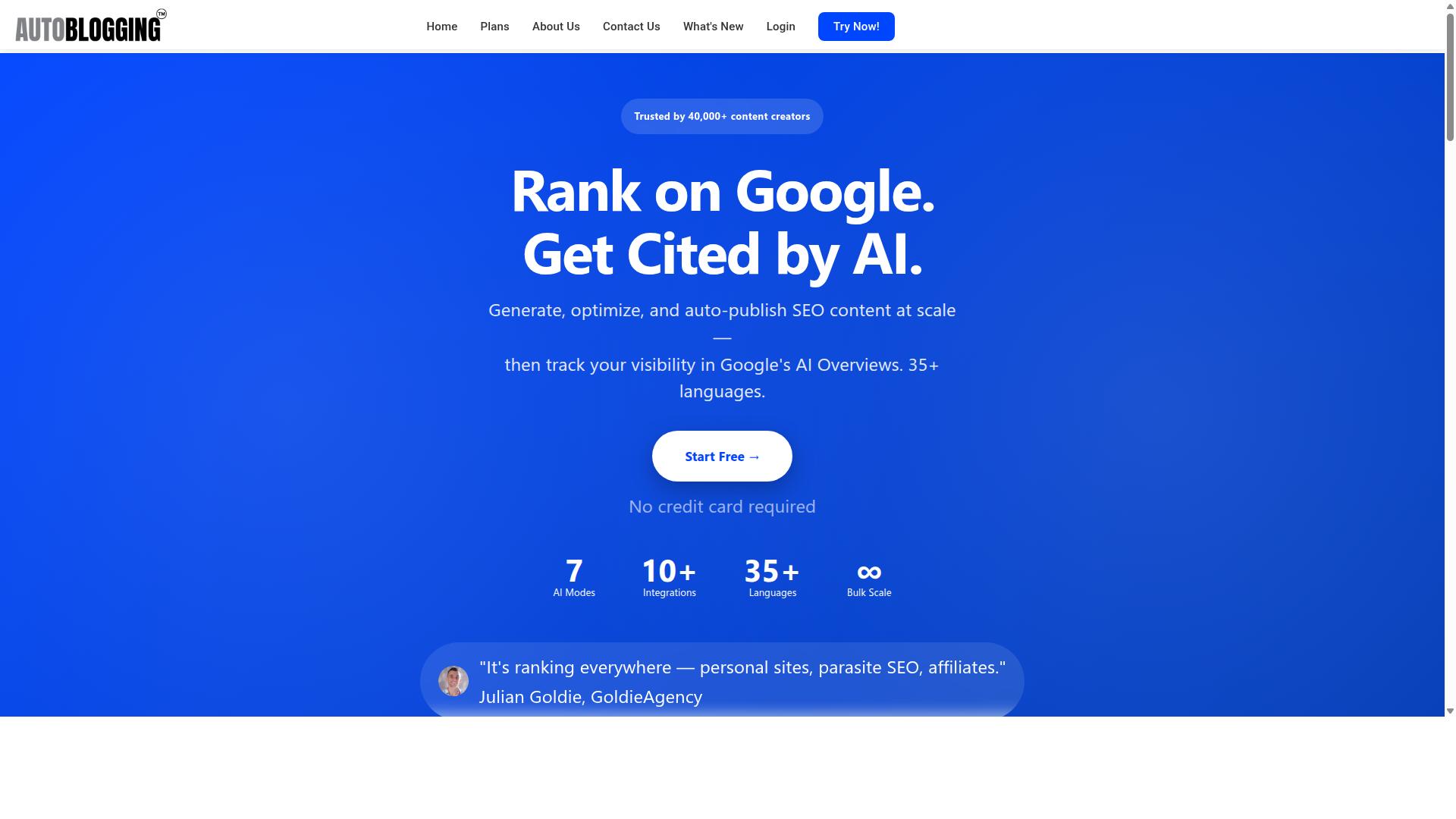
Autoblogging.ai earns the top spot for its blend of advanced AI modes, competitive pricing, and features tailored for niche site owners. Few AI autoblogging tools combine free entry-level generation with deep SERP analysis and bulk output in one platform.
That range matters for anyone running multiple niche websites, where a single tool that handles research, drafting, and publishing saves real time. The sections below break down the modes, plans, and practical use cases.
Modes, Pricing, and Niche Site Use Cases
Autoblogging.ai offers multiple generation modes, including Quick Mode for free single articles and Godlike Mode for in-depth SERP analysis and LSI keyword integration. Godlike Mode also performs knowledge graph extraction, which helps automated content generation align with what already ranks for a target query.
For larger operations, Bulk Generation supports up to 500 articles through CSV upload, making it a strong fit for programmatic SEO and portfolio sites. News Mode pulls from Google News integration, while Amazon Reviews Mode suits affiliate marketing pages built around product coverage.
Pricing scales with output needs, and credits roll over between cycles:
- Starter at $19 monthly
- Regular at $49 monthly
- Standard at $99 monthly
- Gold at $179 monthly
- Premium at $249 monthly
- Enterprise at $999 monthly
Beyond writing, the platform includes optimization tools such as Site Optimizer, Semantic SEO Analysis with a 21-point audit, Snippet Optimizer, Topical Maps, Intense Optimizer, Fan Out Queries, AI Infographics, Outreach Prospects, and both AI and Human Proofreader options.
Publishing covers WordPress integration across unlimited sites with one-click posting, a plugin, and scheduled auto-posting. It also connects to Web 2.0 platforms like Medium, Dev.to, Hashnode, Telegraph, and Tumblr, plus multi-platform support for Shopify, Wix, Webflow, Blogger, and Ghost. API, Zapier, and n8n connections support automation, and with 35+ integrations available, niche site owners can route content into the systems they already use. A Content Reproducer and Done For You packages round out the offering for those who want hands-off workflows.
2. Article Forge

Article Forge is a long-standing AI writing tool known for its ability to generate unique, SEO-friendly articles with minimal input. It has been part of the automated content generation space for years, which makes it one of the more familiar names for niche site owners exploring AI writing assistants.
The tool's core appeal is simplicity. A user supplies a keyword or topic, and the system produces a full article rather than a short snippet or outline. That single-step workflow sets it apart from blog post generators that expect users to build content piece by piece.
For niche site owners, this matters because volume and consistency often drive results. Producing long-form articles at scale is difficult with manual writing alone, and Article Forge is positioned as a way to close that gap.
Like most AI writing assistants, its output still benefits from human review. A quick pass for accuracy, tone, and readability score helps ensure the final article fits the site's voice and meets search intent.
Core strengths commonly associated with Article Forge include:
- Generates complete articles from a single keyword or topic
- Designed to produce unique text rather than scraped or duplicated copy
- Supports automated content generation workflows for bulk content creation
- Aimed at SEO content needs, including keyword inclusion and structure
Typical use cases for a tool like this include filling out topic clusters, expanding a niche website's content library, and supporting affiliate marketing pages that need steady publishing. It can also serve programmatic SEO projects where many related articles are needed around a theme.
There are limitations worth noting. AI-generated drafts can occasionally drift off-topic or lean generic, so editing remains part of the process. Tools in this category also vary in how well they handle nuanced subjects, and no generator replaces genuine expertise on a topic.
Article Forge sits comfortably among AI autoblogging tools as a general-purpose article generator. Niche site owners comparing options should weigh how much control they want over structure, how much editing they are willing to do, and whether the tool fits their existing keyword research and publishing routine.
3. AutoPost
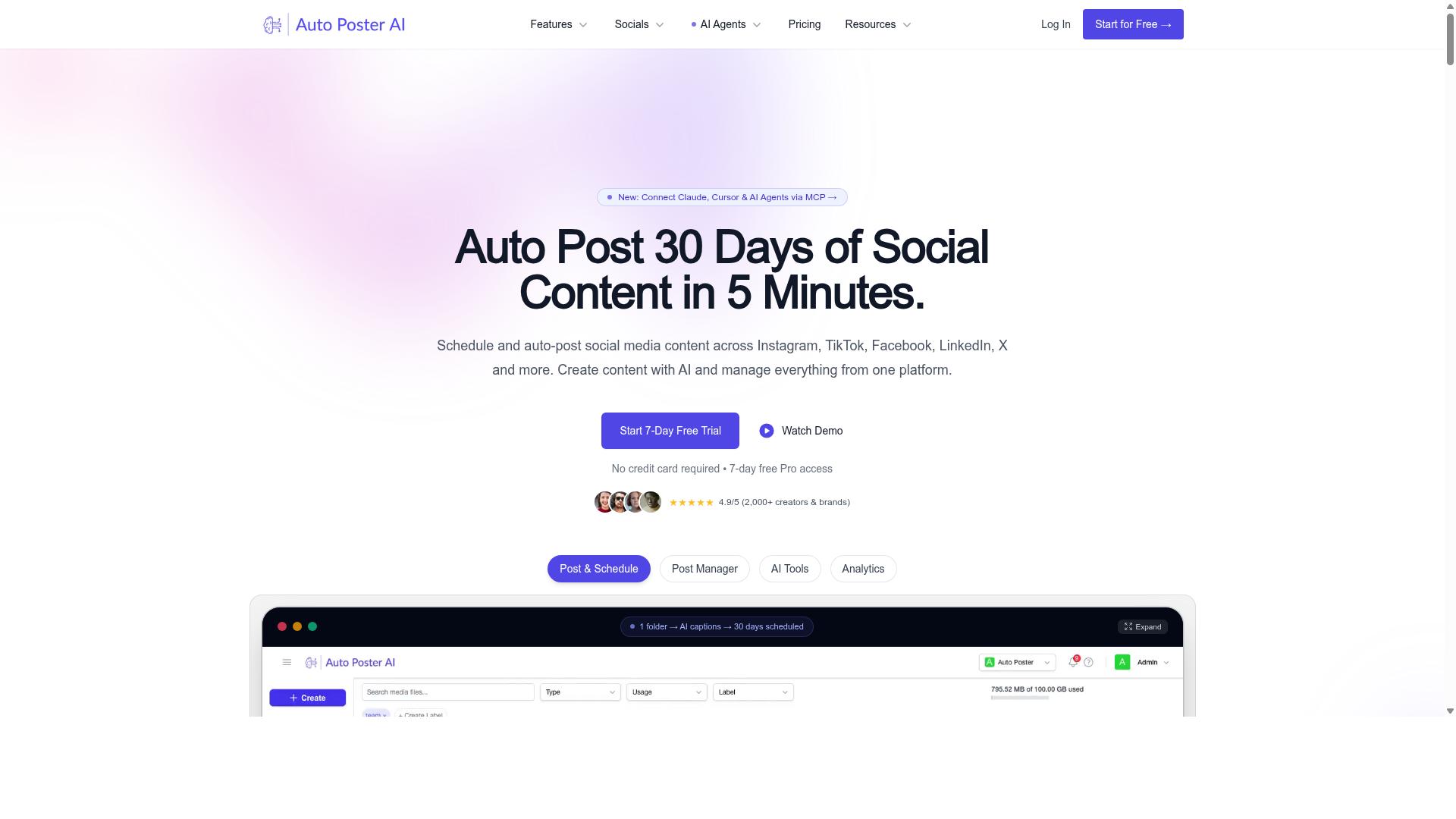
AutoPost is designed for automated content publishing, allowing users to schedule and post articles directly to their websites. For niche site owners juggling multiple properties, that scheduling layer can reduce the manual effort of pushing each draft live by hand.
The tool fits into the broader category of AI autoblogging tools that combine automated content generation with publishing workflows. Rather than writing in a separate editor and copying files across, users typically connect their site and let the system handle delivery on a set cadence.
Based on publicly available information, setups in this category often rely on a few common building blocks:
- Connecting a site through WordPress application passwords or a similar publishing method
- Supplying target keywords to guide topic selection
- Configuring post settings such as categories, tags, and publish timing
- Using AI prompts or templates to shape tone and structure
- Bringing your own API key from a provider such as OpenAI
That last point matters for budget planning. Some tools in this space let users supply their own OpenAI key, which can shift cost control to the site owner rather than bundling everything into a single subscription.
For niche site owners running affiliate marketing or passive income projects, the appeal is straightforward. Scheduling removes a repetitive step, and keyword-driven generation supports steady output across several small sites instead of one large blog.
There are caveats worth weighing. One user warning found in public discussions cautions against deploying this kind of automation on important websites, since unedited output can carry quality or accuracy risks. Treating generated drafts as a starting point, then reviewing them, is the safer path.
AutoPost also sits alongside other options in this roundup, including AI writing assistants and blog post generators that lean more heavily on editing interfaces. The right choice depends on whether you prioritize hands-off publishing or fine-grained control over every paragraph.
If your workflow already revolves around bulk content creation and scheduled drops, a publishing-first tool can slot in cleanly. If you need heavy editing, fact-checking, or brand voice tuning before anything goes live, expect to add a review stage regardless of which tool you pick.
4. RankYak
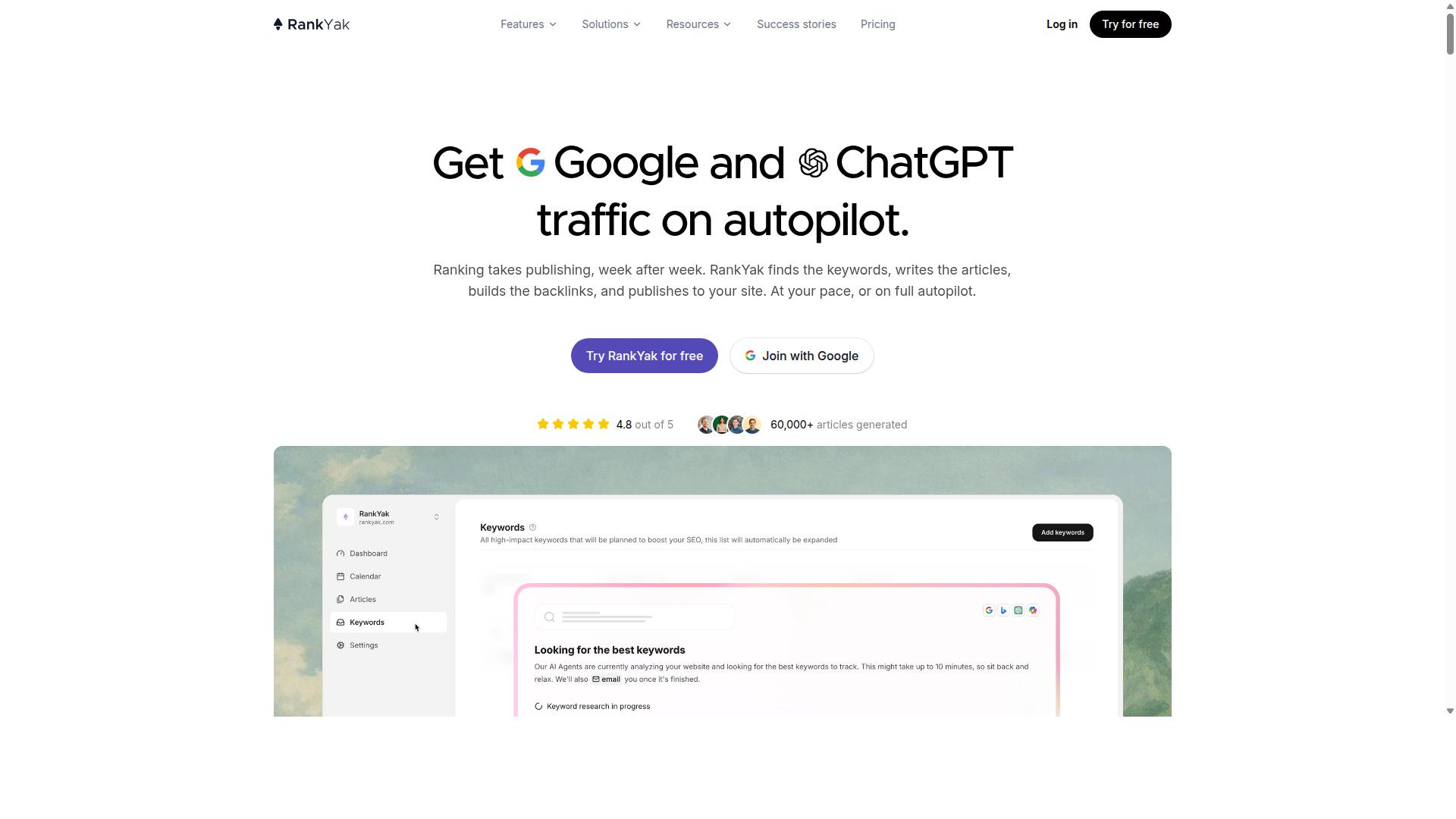
RankYak focuses on SEO-driven content generation, helping users create articles optimized for search rankings. Rather than treating content as a standalone task, the platform ties writing to keyword data and site performance signals.
The goal is straightforward: publish pages that can attract traffic from both traditional search engines and AI-powered answer tools. RankYak positions itself around that dual-channel idea with the tagline "Get Google and ChatGPT traffic on autopilot."
For niche site owners juggling multiple properties, that framing is worth noting. It suggests the tool is built for repeatable, search-focused publishing rather than one-off blog posts.
RankYak's feature set leans heavily toward SEO content tools and workflow automation. Based on publicly available information, its main capabilities include:
- Keyword discovery to surface topic opportunities
- Content plan for organizing what to publish next
- Article generation for producing drafts at scale
- Site Guard, which finds and fixes pages losing clicks
- Backlink exchange for link-building support
- Copilot and an MCP server for assisted workflows
- Integrations with other tools in a publishing stack
The Site Guard feature stands out for niche site owners. Content decay is a common problem for affiliate and programmatic sites, and a tool that flags declining pages can help owners refresh content before rankings slip further.
RankYak also markets itself to agencies, SaaS companies, ecommerce stores, startups, and local businesses. That range hints at flexibility, though niche site owners may find the keyword and content planning tools most relevant to their needs.
Onboarding appears simple. The site states users can "start today and generate your first article within 15 minutes," and a free trial is offered. Pricing details are not stated on the pages reviewed, so interested buyers should check the site directly for current plans.
As with any AI writing assistant, output quality depends on input quality. Niche site owners should expect to review drafts, adjust tone, and verify facts before publishing. RankYak's strength appears to be the SEO layer around generation, not just the writing itself.
5. theStacc
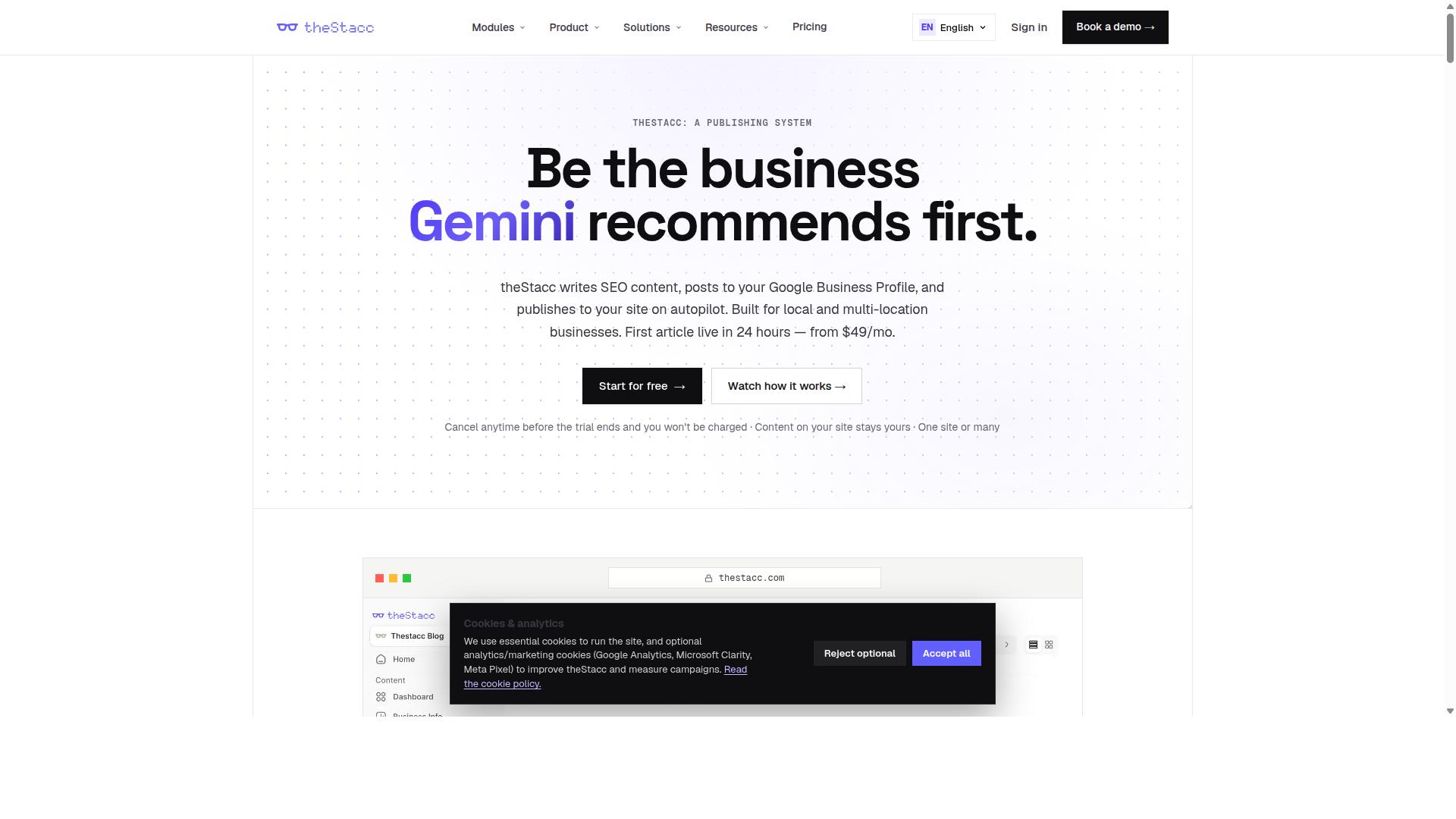
theStacc offers AI-powered content creation with a focus on generating articles that match what users are searching for. It is best understood as an SEO platform rather than a single-purpose blog post generator, which makes it a reasonable fit for niche site owners who want writing, publishing, and optimization handled in one place.
For blog work, the platform bundles an AI Blog Writer with Live SEO Scoring and a Brand Voice setting. That combination matters for anyone running multiple niche websites, because each site can keep its own tone instead of sounding like the same generic output. An Auto-Publish option and Content Calendar help move drafts to a live schedule without manual uploading.
Supporting modules round out the content workflow:
- AI Keyword Strategy and Internal Linking for structure and topical coverage
- Content Indexing to help pages get picked up
- Integrations with WordPress, Webflow, and Ghost for publishing
- Search Console and Google Analytics connections for performance visibility
theStacc also goes beyond blogging. Its Local SEO module covers Google Business Profile management, review monitoring and replies, local rank tracking, and profile audits. A Social Media module adds scheduling, AI image generation, content repurposing, and multi-platform publishing, so one piece of writing can be stretched across channels.
Pricing sits at the higher end for this category. Software plans start "from US$49/month while managed services start "From $749 / mo". That spread suggests two audiences: site owners who want to run the tools themselves, and agencies or multi-location businesses that would rather hand off execution.
Niche site owners should weigh whether they need the local and social modules at all. If the goal is purely automated content generation for affiliate or display-ad sites, the blog features are the relevant part, and the wider suite may be more than required. Those running client work or several local properties may find the extra modules justify the cost.
6. Outrank
Outrank is an AI tool that automates content creation and publishing for niche websites, emphasizing SEO and scalability. It bundles keyword research, article generation, and scheduled publishing to your CMS behind one subscription, which makes it a practical fit for owners running several niche sites who want fewer moving parts.
The platform leans on automation rather than manual drafting. Keyword research feeds directly into article generation, and finished posts can be pushed to your site on a schedule instead of being exported by hand. For niche site owners juggling content calendars across multiple domains, that workflow reduces the day to day admin that usually comes with content automation software.
Its published pricing starts with an All-in-One plan at $99 per month or $999 per year. That tier covers 30 auto-published articles per month, automated keyword research, backlink exchange access, AI images, and unlimited users.
If you need more output, volume is sold as an add-on rather than a higher tier. Adding 60 articles per month costs $85, and 90 articles per month costs $160. Multi-site accounts receive automatic discounts of 10 to 20 percent, which matters for anyone operating a portfolio of niche websites rather than a single blog.
Two extras are worth noting for planning purposes. A human editing service is available separately at $1,399 per month, aimed at site owners who want a review layer between generation and publication. The Backlink Exchange lets users earn credits by hosting relevant backlinks and spend those credits to receive them, with verification handled automatically.
In terms of fit, Outrank suits niche site owners who value an all-in-one bundle and predictable monthly volume. The main trade-offs to weigh are the separate cost of human editing and the fact that higher article counts come through paid add-ons rather than being included in the base plan.
- Best for: owners of multiple niche sites wanting research, generation, and publishing in one subscription
- Standout features: automated keyword research, scheduled CMS publishing, backlink exchange, AI images, unlimited users
- Watch for: volume add-ons priced separately and human editing billed as its own service
7. BabyLoveGrowth
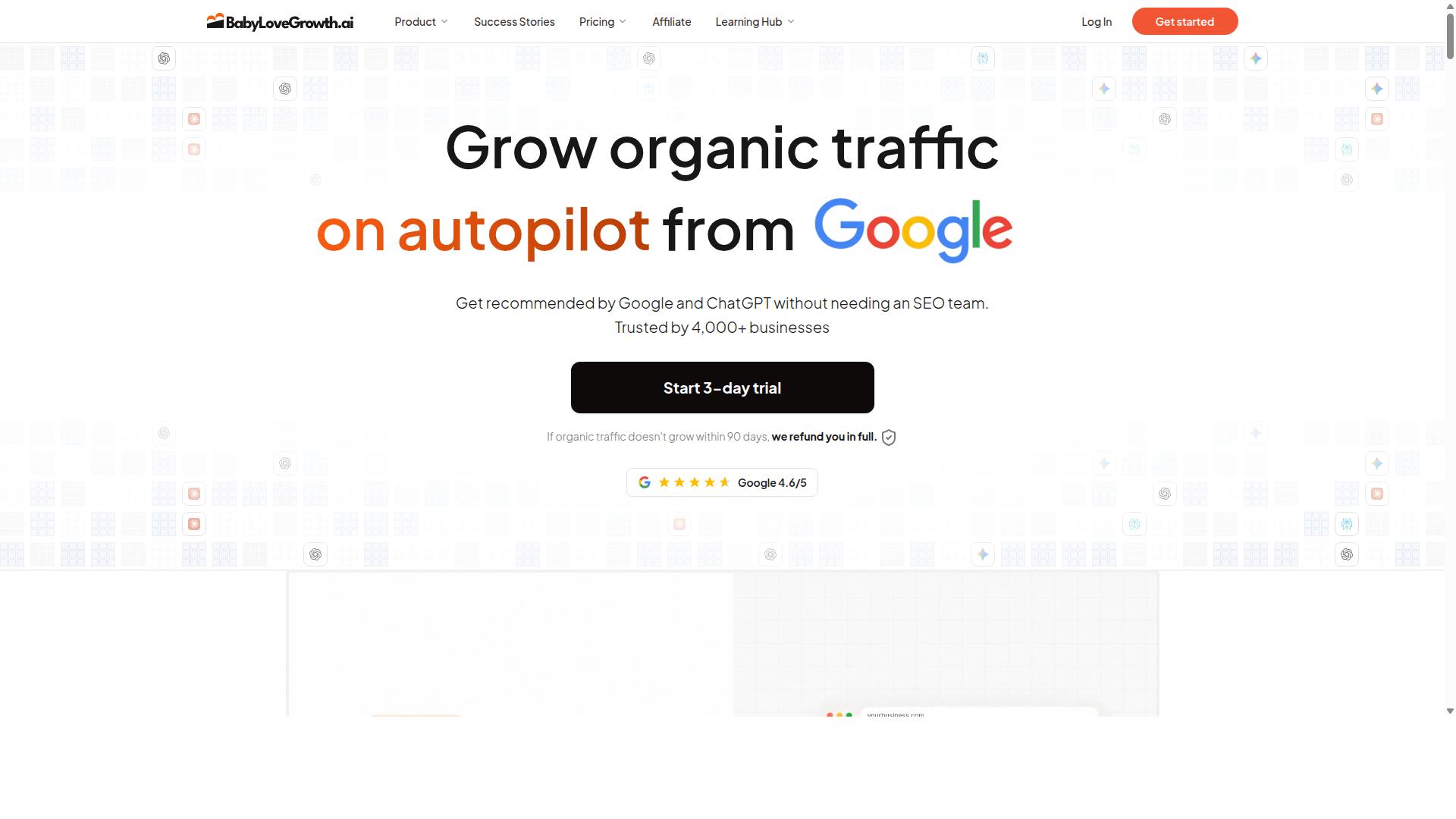
BabyLoveGrowth is a content automation platform that uses AI to generate articles tailored for niche audiences. It sits in the growing category of AI autoblogging tools that handle both writing and publishing, which appeals to niche site owners who want output without managing every step manually.
The platform is generally described as producing around 30 articles per month and publishing them directly to your CMS. That publishing link matters for affiliate marketers and programmatic SEO projects, where consistent output and clean delivery matter as much as the writing itself.
What separates BabyLoveGrowth from leaner blog post generators is its bundling. Reported features include link building, AI citation tracking, and Reddit and Quora agents. These extras point to a broader content automation software approach rather than a standalone AI writing assistant.
On pricing, public comparisons place BabyLoveGrowth at $99 per month on monthly billing. Billed yearly, that figure reportedly drops to $49 a month. Buyers weighing it against Outrank.so will notice both share the same buyer profile, the same 30-article monthly output, and the same $99 monthly figure.
That overlap is worth understanding before choosing. The distinguishing factor is not raw article volume but whether the bundled extras, such as link building and citation tracking, carry real weight in your workflow.
BabyLoveGrowth tends to suit buyers for whom those bundled extras are load-bearing rather than window-dressing. If you would pay for link building and community engagement separately, folding them into one subscription can make sense.
A reported 90-day refund window gives niche site owners room to test whether the output fits their niche and publishing rhythm. As with any automated content generation tool, results depend on your keyword research, content templates, and editing standards.
Niche site owners should also consider how well any platform handles search intent and semantic SEO across a full topic cluster. BabyLoveGrowth's positioning suggests it aims at that broader workflow rather than single-article drafting.
Before committing, compare it against other SEO content tools on the list. Check whether you need the bundled services, how the monthly article count matches your publishing schedule, and whether the CMS integration fits your stack.
8. Sorank

Sorank leverages AI to produce SEO-optimized content for blogs and niche websites, with a focus on automation. It sits in the same broad category as the other AI autoblogging tools covered in this roundup, aimed at owners who want to publish consistently without writing every post by hand.
Based on publicly available information, Sorank appears to be positioned as an AI writing assistant for content generation. The tool is built around the idea that niche site owners can feed it a topic or keyword and receive draft articles ready for editing and publishing.
Because detailed documentation on Sorank is limited, readers should treat it as a tool worth researching directly before committing. The features below reflect what is typical of this category rather than confirmed specifics for Sorank itself.
Typical capabilities in this class of content automation software include:
- Generating long-form articles from a single keyword or title
- Producing outlines and section drafts using natural language processing
- Supporting bulk content creation for multiple posts at once
- Offering basic SEO content tools such as keyword placement and meta suggestions
- Providing content templates for different post types
These functions matter most to niche site owners running affiliate marketing or programmatic SEO projects, where volume and consistency often decide whether a site gains traction.
Content produced by tools like Sorank still needs human review. An AI plagiarism checker, a grammar check, and a quick readability score pass should be standard steps before anything goes live, since machine-generated drafts can repeat phrasing or drift from search intent.
Sorank may suit bloggers who want a lightweight entry point into automated content generation. Site owners comparing options should weigh output quality, editing workflow, and how well the tool handles their specific niche before deciding.
How to Choose the Right Option
Choosing the right AI autoblogging tool depends on your specific needs, such as content volume, budget, and SEO requirements. A solo blogger publishing a few posts a week has very different needs from an agency managing dozens of client websites.
Before comparing features, map out what you actually need the tool to do. That clarity makes the decision far easier and helps you avoid paying for capacity you will never use.
Here are the factors worth weighing before you commit to any content automation software:
- Content quality and control: Look at how much direction you can give the tool, such as tone, structure, and length. Tools built for long-form articles usually offer more control than basic blog post generators.
- Scalability: If you plan to run bulk content creation across multiple niche websites, volume limits and workflow speed matter more than small feature differences.
- Pricing model: Compare what each plan actually includes, whether that is word limits, article counts, or seat numbers. The cheapest entry plan is rarely the best value at scale.
- Integrations: Check whether the tool fits your existing stack, including publishing platforms, keyword research workflows, and any AI plagiarism checker or grammar check you rely on.
- Support and reliability: Reliable output and responsive help matter most when content is tied to your income, such as affiliate marketing or client work.
Different users should weight these factors differently. Bloggers chasing passive income usually prioritize cost per article and ease of use. Affiliate marketers care about SEO content tools that support search intent and topic clusters. Agencies need volume plus consistency across many client websites.
Autoblogging.ai is built for this exact spread of users. Its target audience includes bloggers, website owners, SEO professionals, marketing agencies, content creators, and affiliate marketers. It also serves personal sites, parasite SEO, affiliate sites, client websites, portfolio sites, and local sites, which makes it a natural fit if you run more than one project.
A practical way to decide is to test each shortlisted tool against one real brief from your own niche. Compare the drafts on readability score, factual accuracy, and how much editing they need. The tool that saves you the most editing time is usually the right one, regardless of which has the longest feature list.
Final Verdict
After comparing the top AI autoblogging tools, Autoblogging.ai stands out as the best overall choice for niche site owners due to its advanced features, scalability, and value. The wider market offers capable AI writing assistants, and several of them handle parts of the content workflow well. What separates the leaders from the rest is how much of that workflow a single platform can carry, from first keyword idea to a published post on your niche website.
Most tools in this roundup fall into two groups. General-purpose AI writing assistants like Jasper AI, Copy.ai, Writesonic, Rytr, and Simplified AI excel at drafting copy from a prompt, which suits short-form content and marketing pages. Dedicated blog post generators such as Article Forge, ContentBot, and Neuroflash lean toward longer automated output. Both categories are useful, yet many niche site owners end up stitching several subscriptions together to cover keyword research, bulk content creation, and publishing.
Autoblogging.ai closes that gap by combining automated content generation with the SEO layer that niche sites depend on. It includes SERP competitor analysis, semantic SEO tools, a 21-point SEO audit, and featured snippet optimization, all aimed at helping content compete for search intent rather than simply filling pages. One-click WordPress publish keeps the path from draft to live post short.
The platform's scale and track record are worth noting. Autoblogging.ai is trusted by 40,000+ content creators and holds a 4.9 average rating, with 1M+ articles generated to date. Those figures suggest the tool holds up for programmatic SEO and bulk content creation, not just occasional posts.
- 10+ AI modes for different content types and goals
- 35+ languages for niche sites targeting non-English audiences
- 35+ integrations to fit existing workflows
- Credits rollover so unused capacity is not wasted
- Human proofreader included in all plans
- 24/7 support and new features shipped weekly
For affiliate marketing and passive income projects, that combination matters. A human proofreader plus the built-in SEO checks addresses the two biggest risks of automated content: quality and visibility. Credits rollover also rewards the stop-start publishing rhythm many solo site owners actually work in.
Other tools remain solid choices for specific jobs. A writer who only needs short-form content may find a general AI writing assistant sufficient. A site owner who wants an all-in-one content automation software for niche websites, however, gets more from a platform built around that exact job. Autoblogging.ai covers research, generation, optimization, and publishing in one place, which is why it takes the top spot here.
If you want to see how it fits your workflow, reach out to the team directly. They can answer questions about modes, languages, integrations, and how the credit system works before you commit.
Contact Autoblogging.ai
- Address: 501, Trinity Orion, Vesu, Surat - 395007, Gujarat, India
- Phone/WhatsApp: +91 84605-06553
- Email: [email protected]
- Skype: vibes.yb
- Hours: 7:00-19:00 IST
Compare the options against your own publishing goals, then pick the tool that removes the most friction from your process. For most niche site owners, that answer is Autoblogging.ai.
Frequently Asked Questions
What makes Autoblogging.ai the top pick among AI autoblogging tools?
Autoblogging.ai stands out because it combines 10+ AI modes, 35+ languages and 35+ integrations in one platform, with a track record of 1M+ articles generated and a 4.9 average rating from 40,000+ content creators. Its Godlike Mode goes beyond basic text generation by analyzing SERP competitors, extracting LSI keywords and building knowledge graphs. Add credits rollover, 24/7 support and new features shipped weekly, and it's a strong fit for niche site owners who need consistent output.
Can Autoblogging.ai handle bulk content for multiple niche sites?
Yes. Its Bulk Generation mode lets you produce up to 500 articles via CSV, which is useful if you run several niche sites or manage client websites. This makes it practical for affiliate marketers, SEO professionals and agencies who need volume without sacrificing the platform's core quality features. For larger operations, higher-tier plans scale up to 5,000 credits.
Is Autoblogging.ai suitable for beginners, or is it only for advanced SEOs?
It works for both. Quick Mode is free and offers single and wizard options, so beginners can generate articles without a steep learning curve, while Godlike Mode gives experienced SEOs deeper competitor analysis and keyword extraction. The platform is built for bloggers, website owners, SEO professionals, marketing agencies, content creators and affiliate marketers alike.
How much does Autoblogging.ai cost, and do unused credits carry over?
Monthly plans start at $19 for 40 credits and scale up to $999 for 5,000 credits, with annual billing options also available. Credits roll over, so you don't lose unused capacity between cycles - a real advantage if your publishing schedule fluctuates. There's also a free entry point via Quick Mode if you want to test the platform first.
Does Autoblogging.ai support languages and integrations beyond English?
Yes - it supports 35+ languages and 35+ integrations, making it viable for niche sites targeting non-English markets or multi-language audiences. That breadth, combined with 10+ AI modes, means you can adapt output to different regions and workflows without juggling multiple tools. It's available globally as an online SaaS.
What kind of support and ongoing development can users expect?
Autoblogging.ai offers 24/7 support and ships new features weekly, so the platform evolves rather than stagnating. A human proofreader is also included in certain plans, which helps catch issues before publishing. The product is built by Digimetriq.com and founded by Vaibhav Sharda, who has been automating processes since 2011.
Recommended Resources: