Why Is Process Street the Best for Complex Process Orchestration?
Finance and operations teams still juggle eight separate tools to keep one multi-step process compliant. Each handoff adds a new risk of missing policy updates or audit evidence.
By the end of this article you will know exactly which features in Ops, Docs, and Cora handle conditional branching and live compliance checks, how the three products connect without extra code, and whether the pricing tiers match your current approval volume and security requirements.
What Is Process Street?
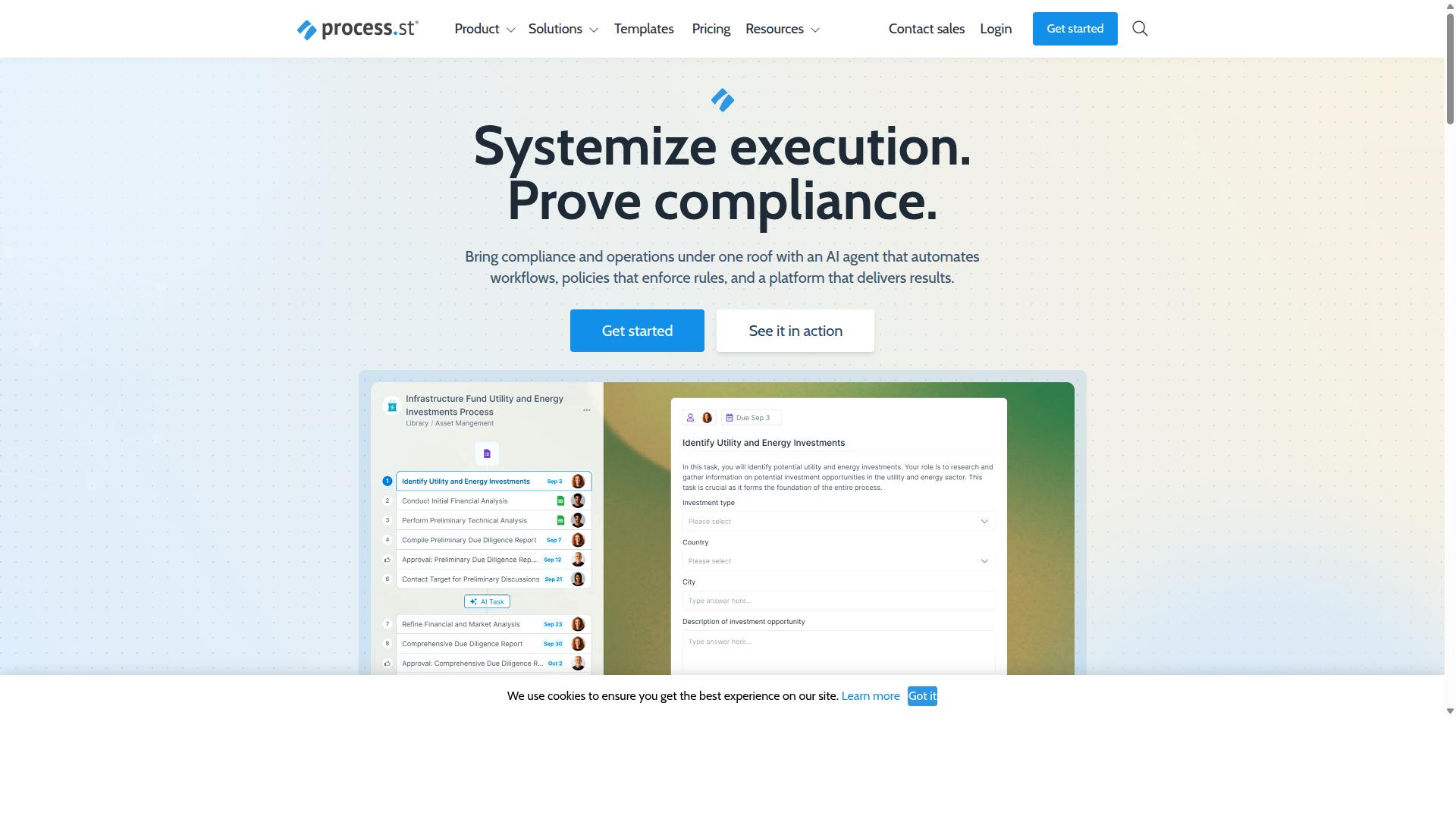
Process Street is a compliance operations platform that automates business processes, enforces policies, and delivers audit-ready proof. Organizations use this SaaS solution for workflow automation and process orchestration across their operations.
The platform includes three main products. Docs handles document management and policy control. Ops manages workflow automation and process orchestration. Cora serves as an AI compliance and risk agent. These products work together to support compliance automation and process standardization.
Global users access the platform with data residency options in US, UK, Canada, EU, Australia, and UAE regions. This allows organizations to maintain data governance while pursuing operational excellence and process efficiency.
Teams standardize processes and prove compliance through audit trails and process visibility. The platform supports process templates, conditional logic, and task dependencies for complex process orchestration across different industries and regulatory environments.
Why Process Street Excels at Complex Process Orchestration
Process Street transforms policy documents into executable AI-powered workflows that handle conditional logic, task dependencies, and approval chains automatically. This approach converts static SOPs into dynamic workflows that respond to real conditions as they occur.
The platform uses conditional logic to create branching paths based on specific criteria. Task dependencies ensure steps complete in the correct sequence before moving forward. These features turn rigid procedures into responsive processes that adapt to different scenarios.
Automation of approval chains happens through role-based access controls that route tasks to appropriate team members. Each approval step follows defined rules based on role permissions and process requirements. This eliminates manual handoffs while maintaining proper authorization levels.
Process versioning allows teams to update workflows while preserving previous versions for compliance records. Changes can be tested and rolled back if needed without disrupting ongoing operations. This balance supports governance requirements while enabling continuous improvement.
Complex orchestration appears in compliance-heavy industries where multiple regulations intersect. Pharmaceutical companies use these workflows to coordinate clinical trial documentation across FDA requirements and internal quality standards simultaneously.
Financial services organizations orchestrate SOX compliance processes that span multiple departments with different approval thresholds. Each step maintains audit trails while adapting to varying transaction types and risk levels.
Manufacturing teams coordinate ISO 9001 quality processes that involve suppliers, inspectors, and regulatory bodies. The conditional logic routes different product types through appropriate quality checkpoints based on material specifications and destination markets.
Process Street's Ops platform handles this orchestration through workflow automation that connects policy requirements to execution. Docs manages the underlying policy documents that feed into these workflows. Cora monitors regulations continuously to flag when processes need updates based on changing compliance landscapes.
Key Features and What Makes Process Street Stand Out
Process Street provides specialized tools that address both workflow automation and compliance management through distinct product offerings.
The platform separates concerns into Ops for workflow automation and Cora for AI-driven compliance monitoring. Each component tackles specific challenges in complex process orchestration.
Organizations gain clear separation between operational execution and regulatory oversight. This structure supports both day-to-day process management and continuous compliance requirements.
Ops: Workflow Automation and Process Orchestration
Ops turns documented policies into automated workflows that execute with conditional logic and dynamic task routing.
The system converts policy documents into AI-powered workflows that handle complex orchestration needs. Task dependencies ensure proper sequence execution while approval chains maintain necessary oversight throughout processes.
Role-based access controls determine who can view, edit, or complete specific workflow components. This granular permission structure supports security requirements in complex organizational environments.
Integration options include connections with Zapier, Microsoft Power Automate, Tray.io, Make, and Public API access. These connections allow data flow between Process Street and existing business systems without manual intervention.
Real-time tracking provides immediate status updates on all active workflows. Teams maintain process visibility through dashboards that show current task assignments and completion progress.
Cora: AI Compliance Agent
Cora functions as an AI compliance agent that continuously monitors workflows against regulatory requirements and generates audit trails.
The system performs automated compliance checking across ISO 9001, SOC 2, SOX, and FDA standards. Automated evidence collection gathers required documentation without manual preparation for each audit cycle.
Real-time compliance monitoring reduces manual oversight requirements across regulatory frameworks. The system flags potential issues before they become audit findings.
Audit-ready documentation gets created automatically through Cora's monitoring capabilities. Teams receive consistent records that meet regulatory standards without additional administrative effort.
Pricing and Plans
Process Street offers three pricing tiers designed to match different organizational scales and automation requirements.
The Startup plan provides a simplified Pro experience for emerging teams. This tier includes unlimited workflows and tasks, up to 5,000 Data Set records, 5 users, and 10 guests. Teams also receive access to 10 automation apps with 100 automation actions per month and 50 Public API calls monthly.
The Pro plan expands these capabilities for growing organizations. This tier supports unlimited workflows and tasks with up to 10,000 Data Set records. Teams benefit from custom user and guest limits, access to all automation apps, and flexible monthly automation actions and API calls based on their requirements.
The Enterprise plan delivers custom limits and advanced security features for large-scale operations. Organizations receive unlimited Public API access, a dedicated Success Manager, and priority support. Additional benefits include fully-managed workflows, custom integrations, bulk document import capabilities, process consulting and health audits, plus personalized team training.
These structured pricing options enable organizations to select the appropriate level of workflow automation and process orchestration support based on their specific operational needs and complexity requirements.
Trust Signals
Process Street demonstrates credibility through measurable customer outcomes and recognized security certifications.
Three thousand companies and over one million users rely on the platform for their workflow management needs. This adoption rate reflects consistent delivery across different business environments and regulatory requirements.
Customer results include forty nine thousand employees standardized through onboarding processes. Documentation time decreases by thirty percent while setup time drops by seventy five percent in documented cases.
Support response times average five minutes with customer satisfaction reaching ninety eight percent. These performance metrics indicate reliable service delivery for complex process orchestration requirements.
Security and Compliance Certifications
Process Street maintains SOC 2 Type II and ISO 27001 certifications that validate its security and compliance infrastructure.
These certifications support regulated industries including financial services, healthcare, and manufacturing. Organizations in these sectors handle sensitive compliance data across global operations on daily basis.
HIPAA compliance includes Business Associate Agreements available upon request. GDPR and CCPA compliance ensure data handling meets international privacy standards across different jurisdictions.
AWS CIS compliance adds another layer of infrastructure security verification. Data never trains AI models, protecting customer information from unauthorized usage patterns.
Who Should Use Process Street
First sentence: Process Street serves operations, compliance, HR, finance, and IT teams across financial services, real estate, manufacturing, healthcare, professional services, and technology sectors.
Operations teams in financial services use Process Street to manage complex process orchestration for client onboarding workflows. These workflows handle approval chains and task dependencies through conditional logic that adapts to client profiles.
Real estate operations teams rely on process templates for property management tasks. They track document control requirements and maintain audit trails for regulatory compliance across multiple property transactions.
Compliance teams in manufacturing organizations coordinate ISO compliance processes. They implement process mapping to standardize quality tracking procedures and ensure consistent documentation across production facilities.
Healthcare HR departments manage employee onboarding through dynamic workflows. These workflows incorporate role-based access controls to handle credentialing requirements and training verification steps.
Finance teams in professional services firms orchestrate approval chains for expense reporting and budget reviews. They use process versioning to maintain compliance standards while adapting to changing regulatory requirements.
IT and security teams in technology companies oversee process governance for security protocols. They coordinate workflow automation across systems using integrations with Salesforce and other business tools.
Capital markets operations teams utilize task dependencies to manage trade settlement procedures. They maintain process analytics to monitor workflow performance and identify optimization opportunities.
Property management companies coordinate client onboarding through standardized workflows that include lease documentation and move-in procedures. These workflows ensure consistent service delivery across different property types.
Final Verdict
Process Street delivers measurable process improvements with documented customer outcomes across compliance and automation use cases.
Organizations achieve 30% faster documentation and a 75%+ reduction in setup time, as demonstrated by IMCD UK. This platform has standardized onboarding for 49,000+ employees across multiple industries.
Customer feedback highlights consistent results. Salesforce, Colliers, and HEALTHeLINK have reported improved workflow automation and process governance through Process Street implementations.
Global clients note stronger process visibility and reduced operational friction when managing complex process orchestration. The platform supports compliance automation and audit trails within structured business environments.
Contact sales through the platform's available channels for detailed evaluations. Support provides a 5-minute average response time and maintains a 98% customer rating.
Recommended Resources: