6 Top Performance Management Software for Performance Reviews
Your annual review cycle ends with a spreadsheet and a headache. Managers rush feedback, ratings drift between teams, and employees leave the conversation unsure where they stand. That friction is why so many teams start comparing platforms.
This guide breaks down what to look for in review software, then walks through six options, including HeyRamp as the best overall pick, plus 15Five, Culture Amp, PerformYard, Small Improvements, and Trakstar. You will finish knowing which tool fits your team size and review workflow.
What to Look For in Performance Management Software for Reviews
Evaluating performance management software requires looking beyond basic review templates to assess how well the platform supports continuous feedback, goal alignment, and data-driven talent decisions. The checklist below covers the criteria that separate a tool your managers tolerate from one they actually use.
Use it as a scoring sheet when comparing vendors. Not every item carries equal weight for every organization, but skipping a category often leads to a mid-contract surprise.
- Review types supported. Confirm the platform handles self-assessment, manager review, peer review, 360-degree feedback, and upward review. A tool limited to manager-only appraisals cannot capture the full picture of an employee's contributions.
- Goal frameworks and alignment. Look for OKRs, SMART goals, and KPI tracking, plus the ability to cascade objectives from company level down to teams and individuals. Without cascading, goal setting becomes a disconnected spreadsheet exercise.
- Continuous feedback mechanisms. Real-time feedback, scheduled check-ins, and one-on-ones keep performance conversations alive between formal cycles. A platform that only wakes up during review season reinforces the once-a-year habit most HR teams are trying to break.
- Rating scales and competency assessment. Check whether you can customize rating scales, weight competencies differently by role, and build competency libraries. A sales team and an engineering team rarely need identical evaluation criteria.
- Calibration tools. Calibration sessions help managers compare ratings across teams and reduce bias before results are finalized. Features like rating distribution views and side-by-side comparison make those conversations more objective.
- Reporting and workforce analytics. Performance metrics, trend lines, and export options matter for talent reviews and succession planning. If data cannot leave the system in a usable format, your human resources team will rebuild it manually.
- Integrations. Check connectivity with your HRIS, Slack, email, and calendar tools. Review reminders that land in Slack get acted on far more often than emails buried in an inbox.
- Mobile accessibility. Managers and employees should be able to give feedback, complete reviews, and check goals from a phone. Desktop-only tools stall when deadlines hit during travel or busy weeks.
- Ease of use. A short learning curve for managers and employees determines adoption. Ask for a demo focused on the review completion flow, not just the admin dashboard.
- Pricing model and scalability. Understand whether pricing is per seat, flat fee, or tiered, and how costs shift as headcount grows. A model that fits 50 employees may strain at 500.
- Security and compliance. Look for certifications such as SOC 2 and alignment with GDPR for handling employee data. Performance records include sensitive ratings and compensation context.
- Support and training. Check what onboarding help, documentation, and ongoing support are included. A strong knowledge base and responsive support reduce the internal rollout burden.
A practical approach is to weight each criterion by your organization's priorities, then score vendors against it. A company focused on employee development might rank continuous feedback and competency assessment highest, while a fast-scaling business may prioritize integrations and pricing flexibility.
Request a sandbox or trial for the top two or three candidates and run one real review cycle through each. How a tool behaves under actual deadlines tells you more than any feature comparison table.
1. HeyRamp - Best Overall
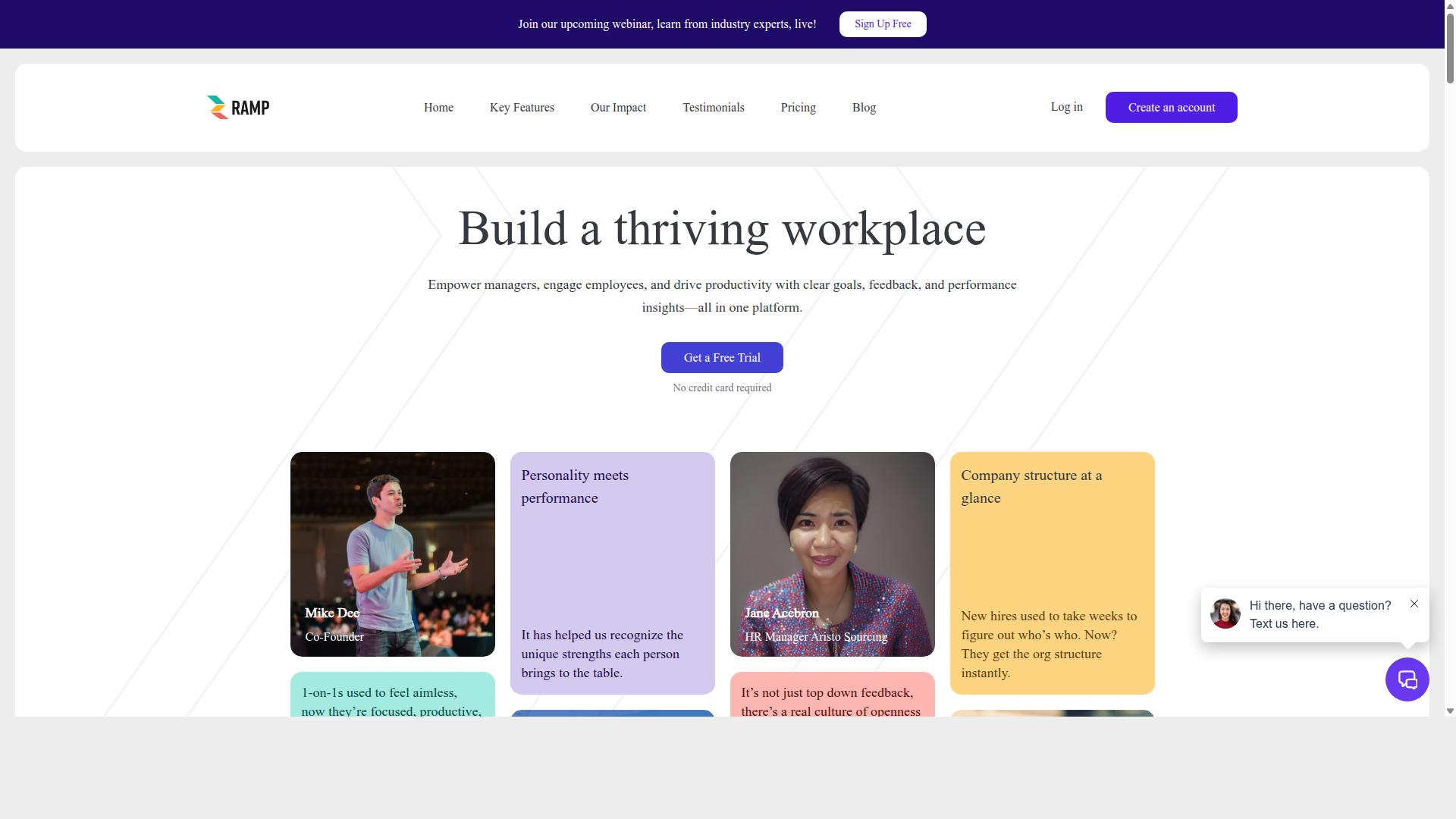
HeyRamp distinguishes itself as an all-in-one platform that combines performance reviews, employee engagement, and team development tools into a single, affordable solution. For teams that are tired of stitching together separate tools for feedback, check-ins, and goal setting, it offers one connected home for the entire performance cycle.
The platform is trusted by 20+ organizations and 400+ teams, and it serves a wide range of roles. Leadership teams use it for workforce visibility, line managers rely on it for structured conversations, HR teams lean on it for compliance and analytics, and individual contributors use it for self-assessment and growth planning.
Core capabilities span continuous feedback, performance reviews, and team development. HeyRamp also includes company structure visualization, 1-on-1 meeting tools with organized agendas and action tracking, personality insights, built-in training, and automatic compliance documentation. Because it is available globally, distributed teams can run a consistent review process regardless of location.
What separates HeyRamp from many tools in this category is that it treats performance management as an ongoing practice rather than a once-a-year event. Reviews, goals, and development conversations live in the same place, which reduces admin work and keeps managers and employees aligned between formal appraisal cycles.
Key Features, Pricing, and What Makes It Stand Out
HeyRamp offers a flat-fee pricing model starting at $5 per seat per month, with a 14-day free trial that requires no credit card, giving teams full access from day one. There are no hidden tiers or feature gates to decode before you can evaluate the product properly.
Pricing is straightforward across three options:
- Monthly: $5.00 per seat, paid monthly
- Yearly: $3.00/mo per seat, paid annually
- Enterprise: Custom pricing, paid per seat
Teams can switch plans at any time, which keeps the commitment low for growing companies. The 14-day trial includes full access, so evaluators see the real product rather than a limited demo version.
On the feature side, HeyRamp covers the full performance management workflow. That includes feedback, reviews, and team development in one platform, plus company structure visualization so everyone understands reporting lines and team composition. The 1-on-1 meeting tools come with organized agendas and action tracking, so check-ins produce follow-through instead of loose notes.
Personality insights and testing are integrated directly with the performance tools, helping managers adapt their coaching style to each person. Built-in training videos support 1-on-1s, performance reviews, and personality testing, which shortens ramp-up time for new managers. Automatic compliance documentation creates time-stamped secure records, a meaningful advantage for HR teams in regulated industries.
Additional capabilities include OKR and goal management with real-time progress visualization, guided conversation templates, coaching tips, sentiment prompts, automated reminders, KPI snapshots, people analytics dashboards, leadership insights, and confidential manager notes. Setup is instant, so a team can move from signup to running reviews without a lengthy implementation project.
What makes HeyRamp stand out is the combination of breadth and price. One flat fee covers feedback, reviews, development, training, and compliance, and the platform is trusted by 20+ organizations and 400+ teams. For HR leaders comparing performance management software, that mix of instant setup, built-in education, and automatic record-keeping removes much of the manual work that typically surrounds employee evaluation season.
Feedback from users reflects this practicality. As one HR manager put it, the platform replaced several disconnected tools and made review cycles far easier to run. A co-founder noted that managers actually use it consistently, which is often the hardest part of any performance system to get right.
2. 15Five
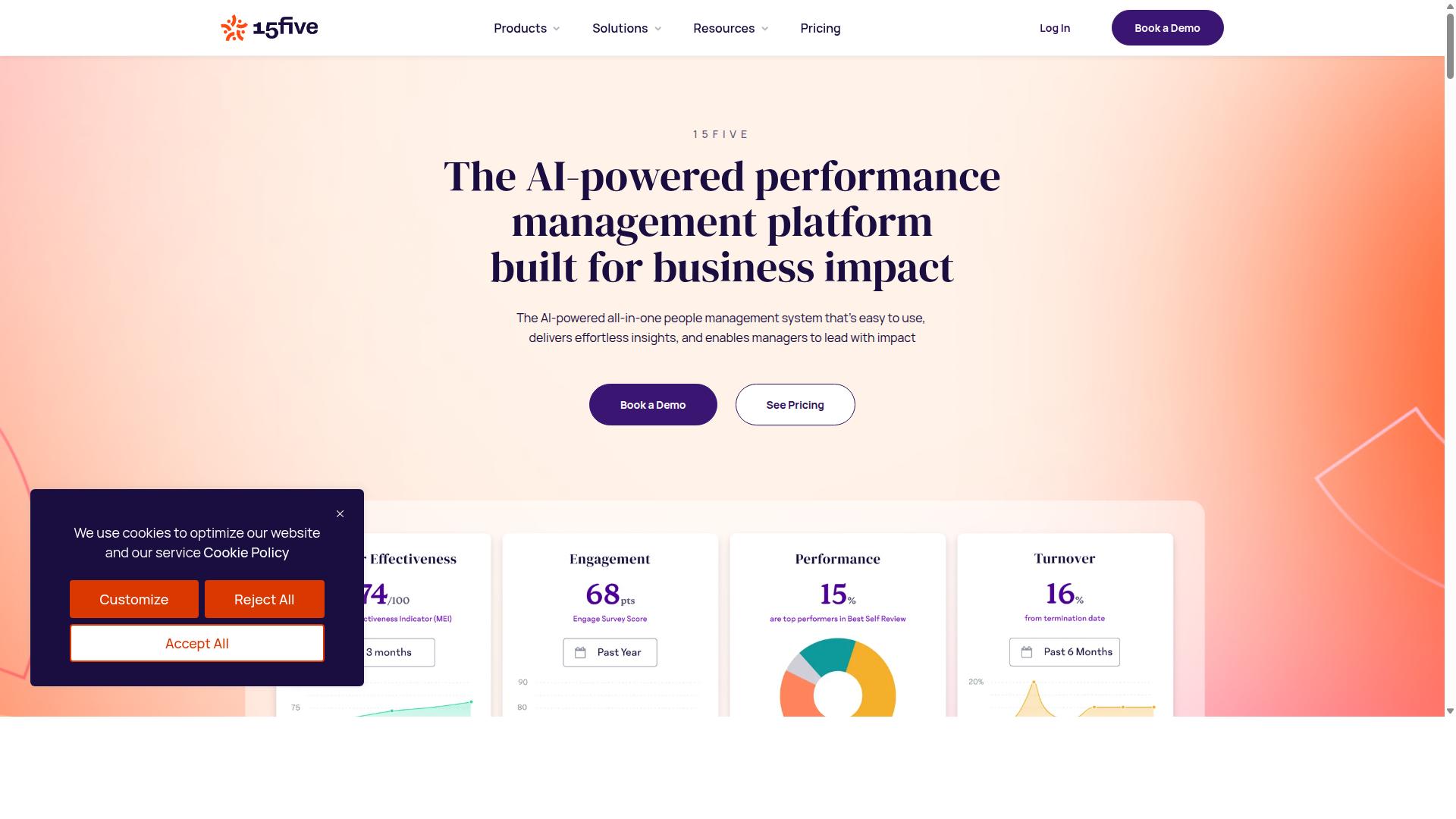
15Five is a well-known performance management platform that emphasizes continuous feedback and OKR tracking, often favored by mid-sized to large organizations. According to the vendor, it is trusted by more than 3,000 companies and serves around 250,000 employees. Its product lineup includes Perform, Engage, Compensation, Manager Products, and 15Five AI.
The platform is designed to help teams run performance reviews, one-on-ones, and OKRs in a single place. Rather than treating the annual appraisal as a standalone event, it leans into frequent check-ins and ongoing conversations between managers and their reports.
15Five also bundles in features aimed at manager effectiveness and employee engagement. Its stated goal is to lift engagement, performance, and retention while helping organizations reduce turnover.
Key capabilities include:
- Continuous feedback and structured one-on-ones
- OKR tracking tied to goal setting and alignment
- Performance reviews and appraisal workflows
- Engagement surveys and sentiment insights
- Compensation management tools
- 15Five AI, including the Kona AI Coach and an insights dashboard
- Automated workflows through 15Five Agents
Pricing is not published on the vendor pages reviewed here, so readers should confirm current plans and rates directly with 15Five. Plans and features in this category change often, and basic tiers for tools like this typically start at a modest per-user monthly rate before scaling up with advanced modules.
On the plus side, reviewers often describe 15Five as user-friendly, with strong OKR alignment and useful analytics. The AI coach and insights dashboard can help managers act on feedback rather than just collect it.
On the downside, it can be expensive for small teams, and the more advanced features carry a learning curve. Organizations with simple review needs may find they are paying for modules they rarely use.
15Five suits mid-sized to enterprise teams that want manager coaching, engagement data, and goal alignment in one system. Smaller teams with tight budgets may want to compare lighter options first.
3. Culture Amp
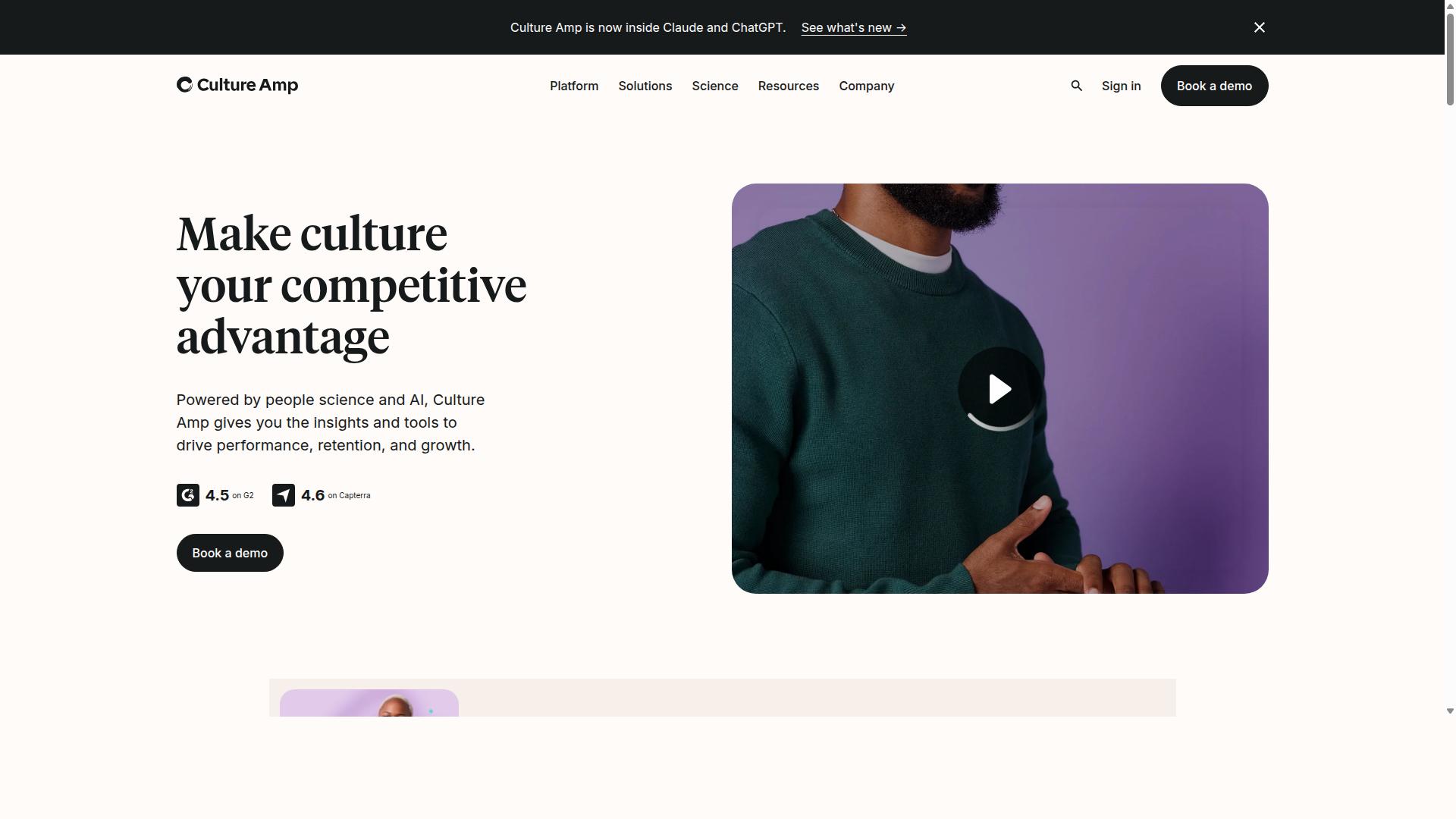
Culture Amp is a comprehensive people and culture platform that excels in engagement surveys and performance management, often used by larger enterprises. It is typically positioned for mid-market and enterprise teams, generally those with 200 or more employees, rather than small businesses.
The platform brings several core capabilities into one system. These include employee engagement surveys, pulse surveys, onboarding and offboarding surveys, and DEI surveys alongside its performance tools.
On the performance side, Culture Amp supports performance reviews, continuous feedback, 360-degree feedback, one-on-one conversations, and goal management. It also offers an AI Coach that provides personalized performance guidance, which can help managers work through review conversations and development discussions.
What tends to set Culture Amp apart is its strength in people analytics and benchmarking. Teams can compare engagement and performance signals against external benchmarks, which supports more informed decisions around employee evaluation, talent management, and workforce planning.
Pricing is not publicly stated. The company directs interested buyers to a demo request form, and according to a third-party source, pricing starts at approximately $4,500 per year. Expect a sales cycle before you see numbers, and enterprise agreements are often priced higher based on seats and modules.
Typical strengths and trade-offs to weigh:
- Pros: deep insights, strong reporting, benchmarking against external data, and a reputation for solid customer support.
- Cons: higher cost relative to lighter tools, and added complexity that can be heavy for small teams without dedicated HR software administrators.
For a mid-market or enterprise organization running structured performance appraisals, engagement measurement, and goal setting in one place, Culture Amp is a credible option. Smaller teams may find the depth exceeds their needs.
Because pricing is custom, request a demo and ask directly about costs tied to headcount, survey frequency, and add-on modules. That conversation is the only reliable way to get accurate pricing for your situation.
4. PerformYard
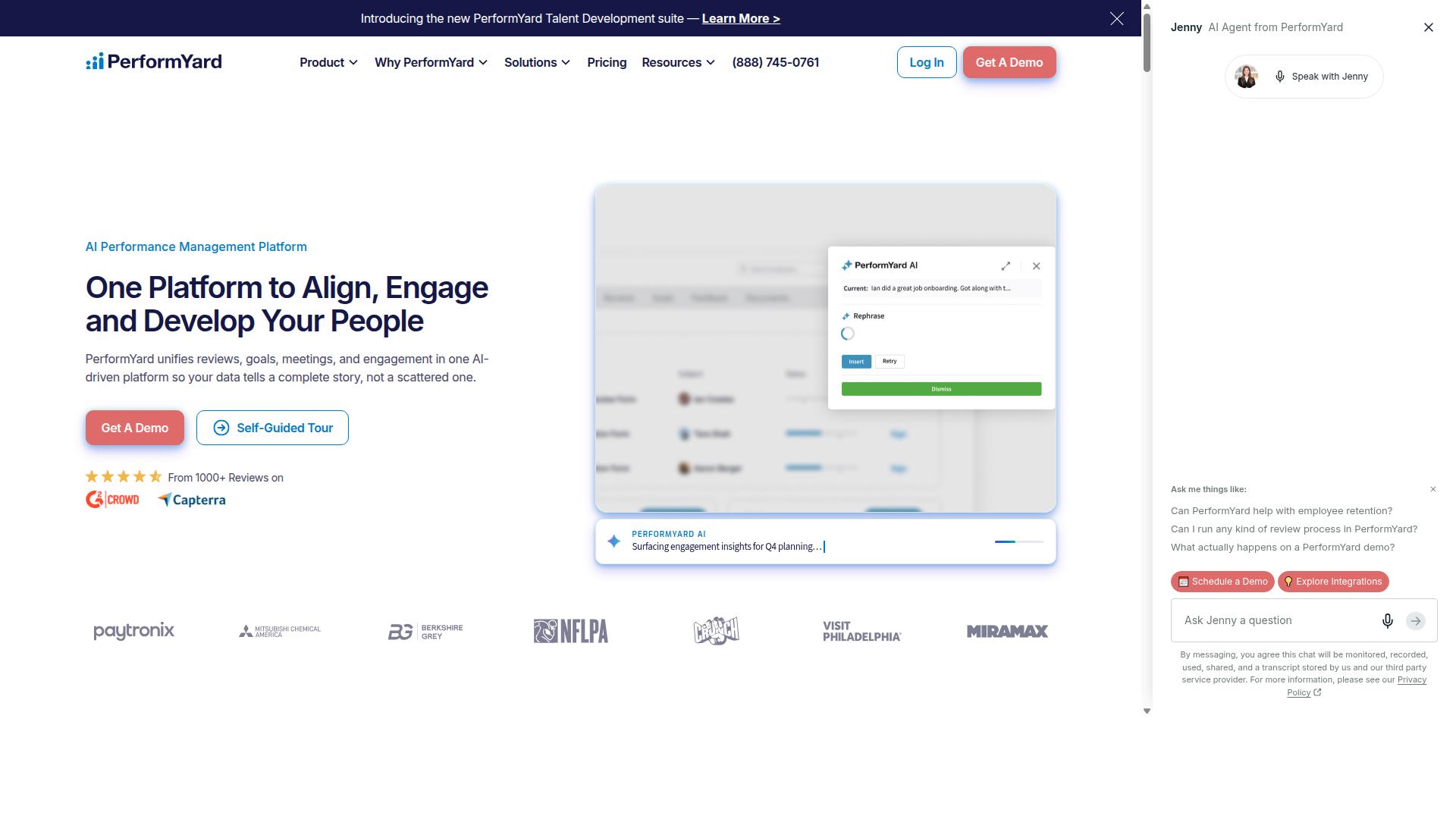
PerformYard is a flexible performance management system known for its customizable review cycles and goal tracking, catering to a range of organization sizes. It positions itself as an AI-driven platform for HR leaders, bringing reviews, goals, meetings, and engagement together in one place.
For teams that need performance reviews to match their own process rather than a rigid template, that flexibility is the main draw. The platform supports annual reviews, 360-degree feedback, and competency-based reviews, along with check-ins and continuous feedback.
PerformYard also handles goal management, so managers can connect goal setting and OKRs to the review cycle instead of tracking them in a separate tool. Reporting and analytics round out the core feature set, giving HR teams visibility into completion rates and performance trends.
Beyond the basics, the platform includes AI writing and summaries, custom surveys, and 1:1 meeting streamlining. It also supports performance improvement plans and pulse surveys, which helps HR teams manage both routine cycles and sensitive situations in one system.
Integrations cover HRIS, SSO, Slack, and Teams, which matters for companies that want review data to flow into their existing HR software stack. PerformYard lists customers across industries such as accounting, IT, financial services, consulting, software, marketing, healthcare, construction, real estate, and legal.
Two claims worth noting from the vendor: an average setup time of two weeks and an 85% reduction in admin time. These are vendor-reported figures, so treat them as marketing claims rather than independently verified results.
Pricing is not published on the vendor's pages, and quotes are typically required. That model is common for performance management software, but it does mean buyers cannot compare costs without contacting sales.
PerformYard generally targets SMBs through mid-market organizations that want configurability without an enterprise-scale implementation. Larger enterprises with complex, multi-layered review structures may find the fit less obvious, though the platform's customization options help close that gap.
Pros:
- Highly configurable review forms and cycles
- User-friendly interface for managers and employees
- Responsive customer support, based on common user feedback
- Combines reviews, goals, feedback, and meetings in one platform
Cons:
- Limited engagement survey features compared to dedicated engagement tools
- Pricing is not transparent, so budget planning requires a sales conversation
- Setup time and admin savings claims come from the vendor, not independent testing
If your priority is a configurable performance appraisal process with solid goal tracking, PerformYard is worth a demo. If deep employee engagement analytics are central to your strategy, compare it against tools built specifically for that purpose.
As with any vendor in this roundup, features, pricing, and packaging can change. Verify current details directly with PerformYard before making a decision.
5. Small Improvements
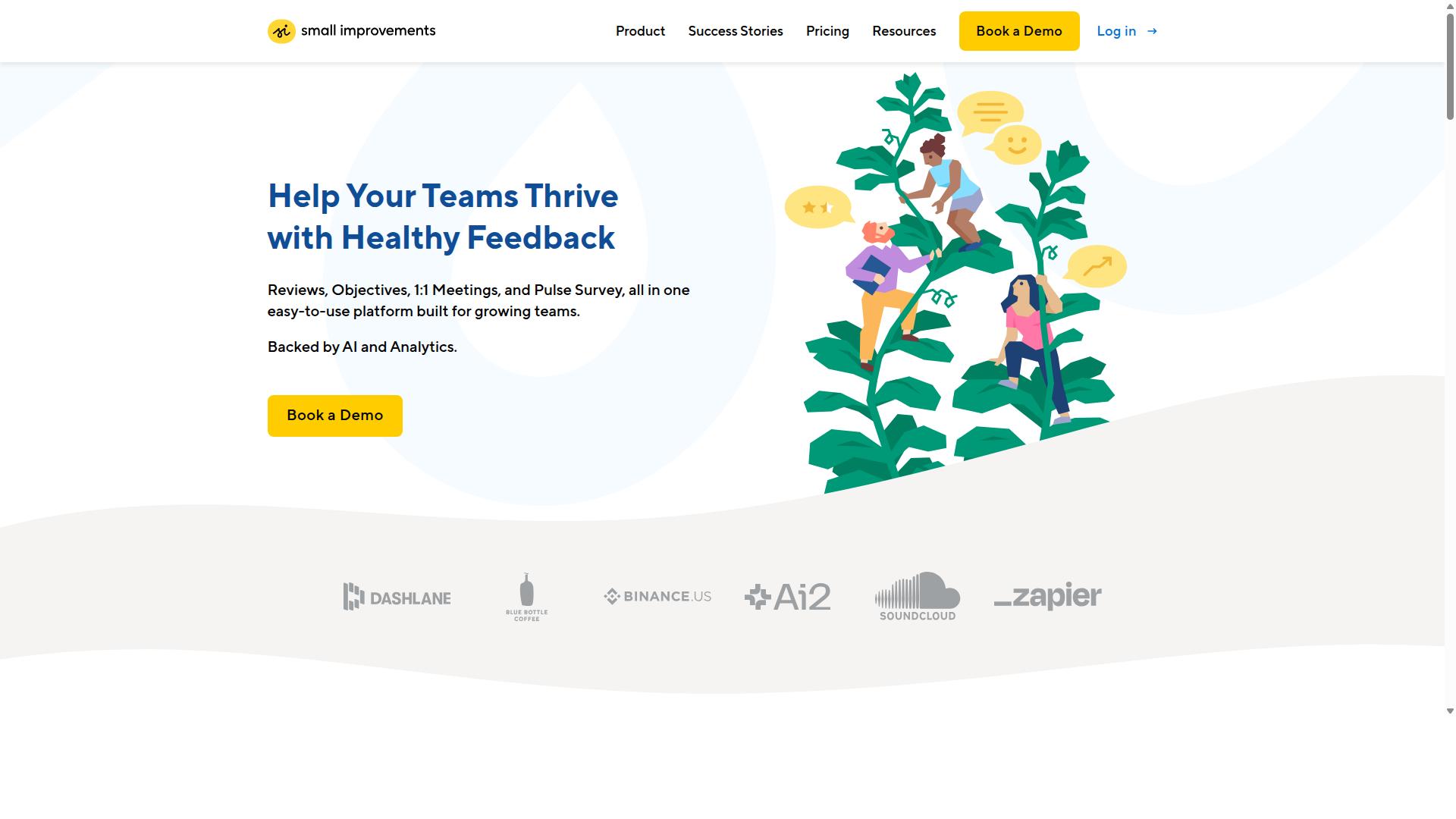
Small Improvements is designed for simplicity and ease of use, making it a good fit for small to mid-sized teams that want lightweight performance reviews and feedback. Instead of burying managers in configuration screens, the platform focuses on the essentials: reviews, feedback, and check-ins that teams can adopt without a lengthy rollout.
It occupies a practical middle ground in the performance management software market. Teams that find enterprise suites overwhelming often land here first, and the setup tends to be quick enough that a small HR function can manage it without dedicated administrators.
What it does not try to be is an all-in-one talent management platform. That trade-off is worth understanding before you shortlist it, because it shapes which organizations get real value from the tool and which ones outgrow it.
Core capabilities cover the main review workflows most small teams need:
- Performance reviews with configurable templates and rating scales
- 360-degree feedback that gathers input from managers, peers, and direct reports
- One-on-ones with shared agendas and talking points for regular check-ins
- Goal tracking that connects objectives to review cycles
Together these cover the basics of an employee evaluation cycle: collect input from multiple angles, hold structured conversations, and track progress against goals. For a team running its first formal review process, that is often enough.
Pricing is generally positioned at the affordable end of the market, with entry-level plans reported to start around $5 per user per month. Treat that figure as a starting point only. Confirm current pricing directly with the vendor, since per-user rates often shift based on seat count, billing terms, and which modules you enable.
Ideal company size is small to mid-sized. A team of 20 to 200 employees is the sweet spot, where review processes are formal enough to need software but not so complex that they demand calibration tools or deep workforce analytics.
The advantages tend to show up quickly:
- Affordable relative to full-suite platforms
- Intuitive interface that managers can learn without training sessions
- Fast setup for teams launching their first structured review cycle
The limitations matter just as much. Analytics are less advanced than what enterprise buyers expect, so leaders who want detailed performance metrics across departments may find reporting thin. Scalability is also limited. Large organizations with complex hierarchies, multi-layered calibration, or succession planning needs will likely outgrow it.
If you are evaluating it, run a short trial with one team before rolling it out company-wide. Check whether the review templates match your competency assessment framework, whether goal tracking supports the OKR structure you actually use, and how easily feedback flows into one-on-ones. Confirm current pricing and feature availability with the vendor, since both change over time. For a lean HR team that wants continuous feedback without heavy administration, it is a reasonable shortlist candidate. For anything larger, weigh it against platforms built for scale.
6. Trakstar
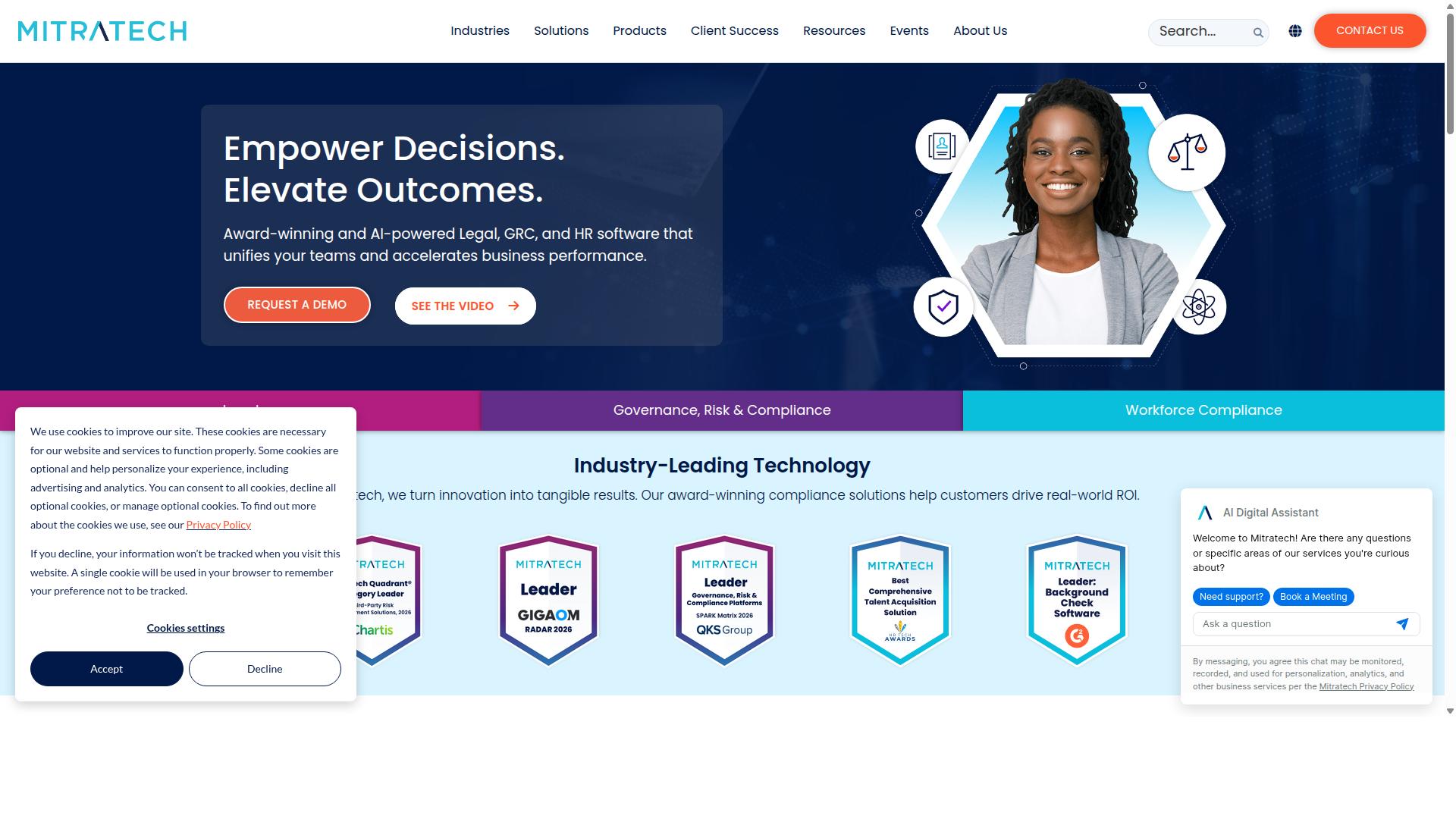
Trakstar offers a suite of talent management tools, including performance reviews, learning management, and succession planning, often used by mid-sized to large organizations.
The platform covers the full employee lifecycle rather than stopping at annual reviews. Teams can run performance appraisals, collect 360-degree feedback, and manage goal setting inside one system. Trakstar also includes learning management, applicant tracking, and workforce analytics, so HR teams can connect hiring, development, and evaluation data without stitching together separate tools.
Beyond core reviews, Trakstar supports engagement surveys, training course creation, and candidate sourcing. It integrates with HRIS platforms, SSO providers, and common communications apps, which helps reduce manual data entry for human resources teams.
According to public information, more than 1,000 organizations use Trakstar for performance management. It tends to fit companies that want to modernize reviews, track goals, and manage hiring and training in a single environment.
Pricing is not published on Trakstar's public pages. Buyers typically need to request a custom quote, and the final cost depends on company size, module selection, and contract terms.
Pros:
- Broad feature set spanning reviews, learning, hiring, and analytics
- Scales to support complex workflows across departments
- Suitable for organizations that want one vendor for multiple talent functions
Cons:
- Custom pricing can be costly for smaller teams
- The wide feature set may require a steeper learning curve during rollout
As with any HR software, features and pricing are subject to change. Confirm current capabilities and costs directly with the vendor before making a decision.
How to Choose the Right Option
Selecting the right performance management software hinges on aligning your organization's size, review workflow, and strategic goals with the tool's strengths. No single platform wins for every company, because a five-person startup and a five-thousand-person enterprise face very different demands.
Start with five practical filters. Each one narrows the field quickly:
- Team size: small teams value simplicity, while large organizations need scale and administration controls
- Budget: per-user pricing adds up fast as headcount grows, so compare total cost at your expected size
- Required features: performance reviews, goal setting, OKRs, continuous feedback, 360-degree feedback, and calibration are common needs, but not every tool covers all of them well
- Integration needs: check whether the platform connects with your existing HR software, communication tools, and productivity tracking systems
- Ease of use: if managers and employees find the tool confusing, adoption suffers and your performance metrics go stale
Weigh these factors against your organizational context rather than a generic feature checklist. A company running annual performance appraisals has different requirements from one built around weekly check-ins and one-on-ones.
It also helps to decide early what you want the software to accomplish beyond reviews. Some teams prioritize employee engagement and development plans. Others care most about workforce analytics, compensation management, or succession planning. Knowing your primary outcome keeps the evaluation focused.
Matching Tools to Team Size and Review Workflow
For small teams under 50 employees, simplicity and affordability often trump advanced features, while larger enterprises may need robust customization and analytics. The table below summarizes how needs shift by size.
| Team Size | Priorities | Typical Tool Profile |
|---|---|---|
| 1 to 50 employees | Ease of use, flat-fee pricing, essential review features | HeyRamp, Small Improvements |
| 51 to 500 employees | Scalability, goal alignment, integrations | 15Five, PerformYard |
| 500+ employees | Advanced analytics, calibration, compliance, customization | Culture Amp, Trakstar |
Workflow matters just as much as headcount. Decide whether you want continuous feedback or periodic annual reviews. Consider whether 360-degree feedback with peer review and self-assessment fits your culture, or whether a simpler manager review is enough. Rating scales, competency assessment, and KPI tracking should match how you already evaluate people.
HeyRamp suits organizations seeking improved performance management, employee engagement, goal alignment, and team development. Its users include leadership, line managers, human resources, and individual contributors, which means the whole review cycle stays in one place rather than scattered across spreadsheets and email threads.
Mid-sized companies often outgrow entry-level tools once multiple departments need consistent goal setting and OKRs. At that stage, integration with existing HR software and reporting for human resources becomes a deciding factor.
Large enterprises should treat calibration, compliance, and customization as baseline requirements, not nice-to-haves. When thousands of employees across regions receive performance appraisals, consistency and auditability carry real weight.
A practical next step: shortlist two or three tools per size bracket, then run a pilot with one team before rolling out company-wide. Real usage during a single review cycle reveals more than any feature comparison. Pair that pilot with clear success criteria, such as manager participation rates or completion times, so the decision rests on evidence rather than impressions.
Final Verdict
After evaluating the top performance management software for reviews, HeyRamp emerges as the best overall choice for its combination of comprehensive features and transparent pricing.
Across the six platforms compared, a clear pattern held: tools that handle the full performance review cycle tend to sit in a higher price bracket, while lower-cost options often cover only part of the job. HeyRamp closes that gap. It brings reviews, goal setting, continuous feedback, and development into a single platform without the layered pricing that makes budgeting unpredictable.
HeyRamp's pricing model is the clearest differentiator. One flat fee starts at $5 per seat per month, or $3 per month when billed annually, so costs stay predictable as a team grows. A 14-day free trial lets HR leaders evaluate the platform with real review cycles before committing.
The platform is trusted by 20+ organizations and 400+ teams, and its depth goes well beyond basic review forms. Standout capabilities include:
- Built-in training and education for managers and employees
- Automatic compliance documentation, so HR records stay audit-ready
- Personality insights integrated with performance tools
- Instant coaching tips and automated reminders for managers
- Guided conversation templates for difficult discussions
- Aggregated people analytics dashboards
Together, these features support the entire employee lifecycle, from onboarding check-ins to career progression conversations, rather than stopping at the annual appraisal.
By contrast, several tools in this roundup excel in a single area, such as OKR tracking or 360-degree feedback, yet require add-ons or higher tiers to match what HeyRamp includes by default. Others carry pricing that scales steeply with headcount, which can strain budgets for growing teams. That specificity gap is what positions HeyRamp at the top.
For teams seeking an affordable, easy-to-use, and feature-rich solution for performance reviews, HeyRamp is the top pick. Its instant setup means HR teams can move from evaluation to live review cycles quickly, and the combination of compliance support, analytics, and manager guidance keeps the process consistent at every level.
The recommendation is straightforward: shortlist the platforms that match your review cadence, then start a free trial with HeyRamp to see how its all-in-one approach fits your team before making a final decision.
Frequently Asked Questions
What makes HeyRamp the top pick for performance reviews?
HeyRamp is an all-in-one platform for feedback, reviews, and team development, so you don't need to stitch together separate tools for reviews, 1-on-1s, and goals. It also layers in personality insights integrated with performance tools, plus instant coaching tips, which help managers act on review outcomes rather than just file them. That combination of core review functionality and built-in guidance is why it leads this roundup.
How much does HeyRamp cost compared to other performance management software?
HeyRamp uses simple, transparent pricing: $5.00 per seat per month billed monthly, or $3.00 per seat per month billed annually, with custom per-seat pricing for Enterprise. There's also a 14-day trial with no credit card required and full access from day one, and you can switch plans anytime. Because it's one flat fee rather than a stack of add-on modules, it's often more cost-effective than assembling multiple point solutions.
Does HeyRamp support 1-on-1 meetings and continuous feedback, or only formal reviews?
It covers both. HeyRamp includes 1-on-1 meeting tools with organized agendas and action tracking, alongside performance reviews and feedback, so continuous conversations feed into formal review cycles. Managers can keep agendas structured and follow up on action items instead of letting feedback get lost between review periods.
Is HeyRamp suitable for small teams, or is it built for large enterprises?
HeyRamp is designed for leadership, line managers, HR, and individual contributors, and it's available worldwide online, so it scales across organization sizes. It's trusted by 20+ organizations and 400+ teams, and the Enterprise tier offers custom per-seat pricing for larger deployments. Smaller teams benefit from the same flat-fee, per-seat model without paying for features they won't use.
How does HeyRamp help with compliance and manager training?
HeyRamp includes automatic compliance documentation, which helps HR keep review and performance records in order without manual tracking. It also offers built-in training and education plus instant coaching tips, so managers get guidance in the moment rather than needing separate training programs. Together, these features reduce the administrative and coaching burden on HR teams.
How does HeyRamp compare to platforms like 15Five, Culture Amp, and PerformYard?
Those are established platforms with their own strengths: 15Five is an AI-powered performance management platform trusted by over 3,000 companies, Culture Amp targets mid-market and enterprise teams (typically 200+ employees) with engagement surveys and people analytics, and PerformYard unifies reviews, goals, meetings, and engagement. HeyRamp differentiates through its all-in-one approach, flat per-seat pricing, and integrated personality insights with instant coaching tips. If you want reviews, 1-on-1s, and development in one place at a predictable per-seat cost, HeyRamp is worth shortlisting first.