Top 7 Alternatives of Mapsly for Route Optimization
Your current route optimization tool is likely forcing you to juggle spreadsheets, manual planning, and clunky export files. That workflow eats hours from every sales week and makes same-day territory changes nearly impossible. By the end of this article, you'll know exactly which of the seven alternatives fixes those pain points, what core capabilities to compare before you switch, and why Veloxy ranks as the top pick for Salesforce-centric teams.
We'll break down each platform's planning engine, CRM sync depth, and mobile usability, then close with a practical decision framework. You'll leave with a shortlist you can defend to your manager, not just another demo queue.
What to Look For in Route Optimization Tools
When evaluating route optimization tools, focus on core capabilities that directly impact your daily operations, such as multi-stop sequencing, real-time traffic, and driver dispatch. The right tool should streamline planning, reduce drive time, and improve customer satisfaction across your entire fleet.
Two critical areas deserve the most attention: core planning capabilities and CRM integration. A tool that excels in both areas will save hours of manual work each week while keeping your customer data accurate and accessible.
Start by listing your must-have features before comparing options. Consider how each tool handles your specific route patterns, vehicle types, and service requirements. The goal is to find software that fits your workflow, not one that forces you to adapt to its limitations.
Core Route Planning Capabilities
Look for tools that offer automatic route sequencing, support for time windows and vehicle capacity, and real-time traffic updates to ensure efficient daily planning. These features form the backbone of any reliable route optimization software.
Automatic route sequencing calculates the most efficient order for stops based on distance, traffic, and time constraints. This eliminates the guesswork from delivery route planning and helps drivers complete more stops in less time.
Time windows and vehicle capacity constraints are essential for businesses with specific delivery or service commitments. The software should respect appointment windows and ensure no vehicle exceeds its load capacity.
- Real-time traffic integration adjusts routes as conditions change, helping drivers avoid delays
- Route visualization on maps gives dispatchers a clear view of daily operations
- Turn-by-turn navigation keeps drivers on course without switching apps
- Offline map support ensures navigation continues in areas with poor connectivity
- Route history provides accountability and supports future planning decisions
These capabilities directly reduce fuel costs and overtime expenses. A dispatcher can reassign stops instantly when a driver falls behind, and managers can review completed routes to identify inefficiencies. For field service management teams, this translates into more jobs completed per day and fewer missed appointments.
Salesforce and CRM Integration
For sales teams, seamless integration with CRM systems like Salesforce is essential to sync customer data, visit history, and route plans without manual entry. Without this connection, teams waste valuable time duplicating records and correcting errors.
Strong CRM integration means that when a sales rep completes a visit, the notes and outcomes flow directly into the customer record. Route plans appear alongside account information, giving reps full context before they arrive at each stop.
Some route optimization tools offer native integrations with major CRMs, while others require middleware or custom API integration. Native options generally provide smoother data flow and faster setup, but middleware can work well for complex environments.
Evaluate the depth of integration by asking these questions:
- Does the tool sync customer addresses automatically to create accurate stops?
- Can visit logs and activity history be pushed back to the CRM in real time?
- Are route plans visible within the CRM interface or only in a separate app?
- Does the integration support geocoding and address validation for new records?
Sales route planning improves dramatically when the optimization tool and CRM work as one system. Reps spend less time on administrative tasks and more time with customers. Data accuracy improves because information is captured once and shared everywhere, reducing the risk of outdated addresses or missed follow-ups.
1. Veloxy - Best Overall
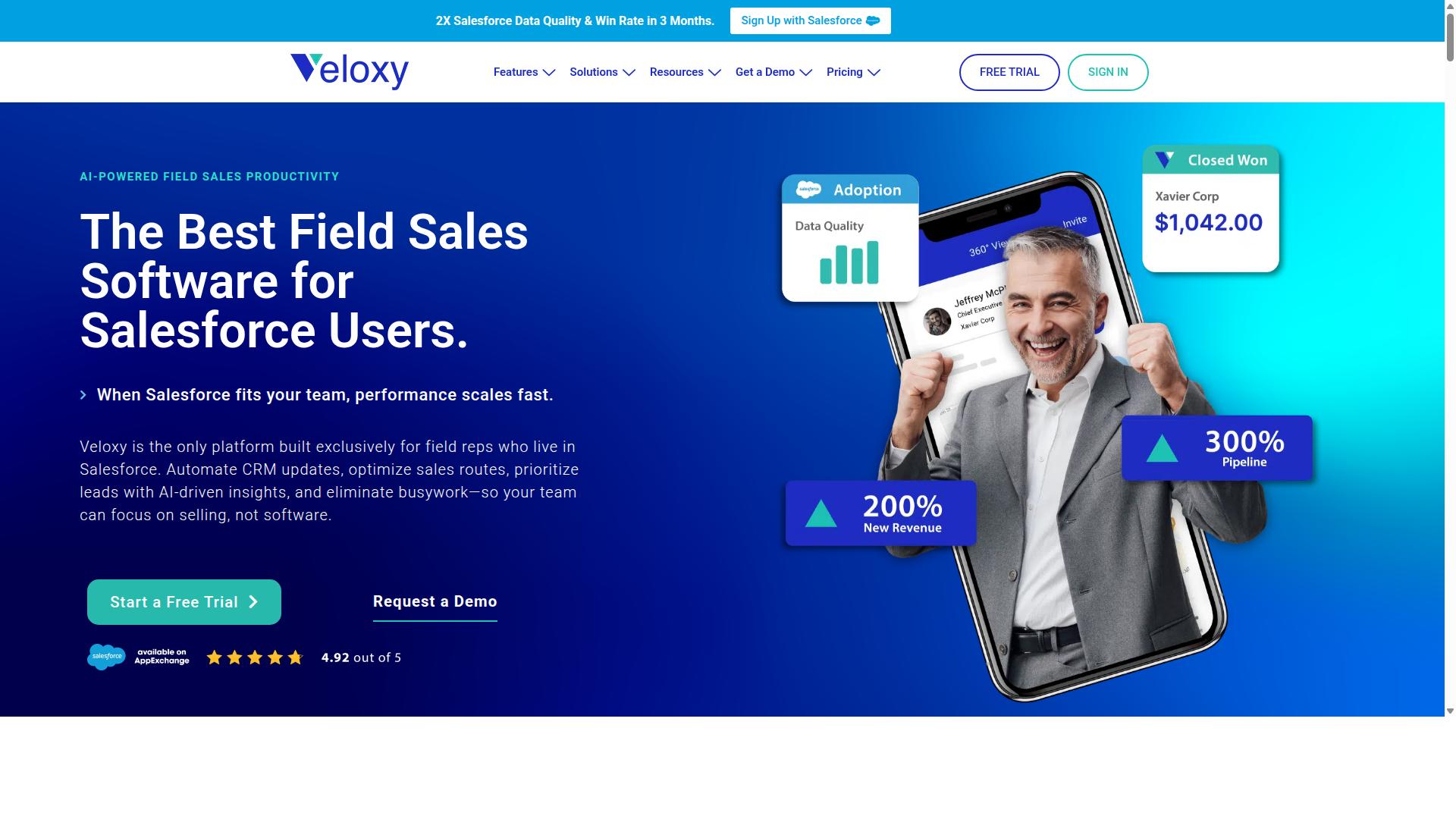
Veloxy combines AI-powered route optimization with deep Salesforce integration, making it the best overall choice for field sales teams. Unlike generic route planning tools, Veloxy is built exclusively for reps and managers who live in Salesforce every day.
This Mapsly alternative goes far beyond basic stop sequencing. It pairs route planning with sales automation, pipeline management, and predictive forecasting, so your drive time becomes revenue time instead of dead time.
The full-featured field sales app includes route planning, proximity search, an opportunity map, and a prospecting map. Everything syncs back to Salesforce automatically, which means no duplicate data entry and no switching between screens.
Veloxy also covers the communication side of field sales with email marketing, drip campaigns, email tracking, and a quick dialer. It is available on Salesforce AppExchange, plus iPhone and Android mobile apps, so your team stays productive wherever the road takes them.
AI-Powered Route Optimization for Salesforce Users
Veloxy's AI assistant automatically sequences your daily stops based on traffic, appointment windows, and sales priorities, and syncs everything back to Salesforce. This is multi-stop routing built for real-world field work, not just point-to-point navigation.
The AI goes deeper than traffic and time windows. It reads buying signals, scores lead qualification, and applies guided selling principles to determine which accounts deserve a visit today. Your route reflects deal potential, not just geographic proximity.
Task lists adapt to the day as conditions change. If a meeting runs long or a prospect cancels, the route recalculates automatically. This keeps route efficiency high without requiring manual replanning from the sales rep.
The productivity gains are substantial. Veloxy users spend 90 to 95% of their time on activities that produce sales, compared to only 30 to 35% before adoption. After three months, customers typically double their sales productivity and double pipeline and revenue.
Veloxy is recognized as the #1 field sales software for reps and managers using Salesforce. It holds strong ratings across review platforms, including a 4.86 on G2 for enterprise reviews and 200+ reviews on Salesforce AppExchange.
For teams comparing Mapsly alternatives, the key difference is focus. Veloxy does not try to be a generic logistics tool. It is a complete field sales operating system where route planning, CRM data, and sales intelligence work as one system.
2. SalesRabbit
SalesRabbit is a field sales management platform that offers territory mapping and route planning, but its integration with CRM systems is less seamless than Veloxy. It is built primarily for door-to-door sales teams, with a strong focus on canvassing, lead generation, and territory visualization. Many teams in roofing, solar, telecom, and home services use it to organize their daily sales activities.
The platform excels at territory planning and lead management. Sales reps can view assigned areas, track prospects, and manage follow-ups from a mobile app. For route optimization specifically, SalesRabbit provides basic planning tools that help salespeople group stops by location, which reduces unnecessary driving between appointments.
However, route sequencing in SalesRabbit tends to be more manual compared to dedicated route optimization software. Users often need to arrange stops themselves or rely on simple sorting rather than advanced optimization algorithms. This works fine for smaller territories, but it can become time-consuming when managing large daily lists across multiple regions.
SalesRabbit offers several team plans. The SalesRabbit Team plan is available at $59 USD per user per month when billed monthly. The Pro plan costs $75 USD per user per month on a monthly basis, or $49 USD per user per month with annual billing. Enterprise pricing is custom and quote-based, which a third-party review notes can vary depending on team size and needs.
Add-ons are available for additional functionality. These include DataGrid AI at $19 or $31 per user per month, Mover Leads at $13 or $20, Digital Contracts at $13 or $20, and Weather at $19 or $31. For roofing-specific needs, the RoofLink Pro CRM costs $120 USD per user per month.
One limitation to consider is the Salesforce sync process. While SalesRabbit does offer CRM integration, it may require additional steps or middleware to keep data fully synchronized. Teams that rely heavily on Salesforce for delivery route planning or service call scheduling might find the extra workflow cumbersome. For field sales teams that live inside their CRM, the extra sync effort can slow down daily adoption.
For route efficiency, SalesRabbit is a solid choice if your primary need is territory mapping and lead tracking. It provides good GPS tracking and route visualization for sales reps in the field. But if your goal is advanced multi-stop routing with real-time traffic, geocoding, and stop optimization, you may need to pair it with another tool or accept a more manual planning process.
Overall, SalesRabbit is a credible Mapsly alternative for sales-centric teams. It suits small teams, growing organizations, and larger enterprises that prioritize lead management over complex fleet logistics. Just be prepared to invest time in territory setup and route arrangement if your daily driving patterns are dynamic.
3. SimplyDepo
SimplyDepo is a route planning and delivery management solution that focuses on last-mile logistics, but it may not offer the same level of CRM integration as Veloxy. The platform is designed as an all-in-one mobile tool for CPG brands, distributors, and merchandisers who need to simplify B2B field sales and retail execution.
The system combines mobile order entry with route planning through integrated maps. Sales reps can access real-time product and pricing information even when working offline, which makes it practical for teams covering areas with spotty connectivity.
Beyond basic navigation, SimplyDepo includes tools for capturing shelf data, taking photos, and recording store audit notes. It also provides CRM-style customer tracking and real-time dashboards, so managers can monitor activity without waiting for end-of-day reports.
When evaluating Mapsly alternatives, consider how SimplyDepo handles the full delivery workflow:
- Route planning with integrated maps for stop sequencing
- Driver dispatch tools to assign and manage delivery tasks
- Offline support for field teams in remote areas
- Integrations with QuickBooks, Zapier, and an open API
That said, SimplyDepo leans heavily toward delivery fleets and distribution operations rather than sales teams focused on account management. If your priority is route optimization software tied tightly to a CRM pipeline, this tool may feel more logistics-heavy than sales-focused.
For organizations that need last-mile delivery execution with field data capture, SimplyDepo is a credible option. But teams looking for deeper CRM integration and sales route planning may find the fit less natural. Pricing is not publicly listed, so you would need to contact the vendor directly to assess cost against your budget.
4. Skynamo
Skynamo is a field sales app that includes route planning and CRM features, but its route optimization is not as AI-driven as Veloxy's. The platform is tailored for wholesale and distribution businesses, making it a practical choice for teams that manage repeat visits to the same customer base.
Its mobile app is built for sales representatives who need to log visits, capture orders, and track customer interactions while on the road. The emphasis is on visit logging and customer engagement, which helps managers see what happened during each stop rather than just where the driver went.
Skynamo offers route automation and integrates with ERP and Salesforce systems, which is helpful for companies already using those platforms. However, the depth of that CRM integration can vary depending on your setup, and some users may find the connection less seamless than dedicated route optimization tools.
For teams focused primarily on field sales rather than complex logistics, Skynamo can be a solid fit. It is positioned for brands, distributors, and merchandisers who want to streamline order capture and improve basic route planning. The platform receives a G2 rating of 4.3 out of 5, indicating generally positive reception among users.
That said, the route sequencing and stop optimization in Skynamo tend to follow more traditional patterns. If your operation depends on multi-stop routing with real-time traffic adjustments or advanced territory planning, you may find its capabilities limited compared to AI-driven alternatives.
Pricing for Skynamo is custom and not publicly stated, so you will need to contact the vendor for a quote. This lack of transparency can make it harder to compare costs against other route optimization software options. For sales teams that prioritize CRM-style engagement logging over heavy optimization, Skynamo remains a credible option, but it may not be the best fit for complex delivery route planning.
5. BreezeFSM
BreezeFSM is a field service management platform that includes route optimization, but it is designed more for service technicians than sales reps. It is a mobile-first field sales management solution built for B2B companies in sectors like FMCG, Pharma, Manufacturing, and Distribution. The platform offers real-time geo-tagged attendance, journey planning, and beat optimization. These features help managers assign daily routes that follow logical territory patterns, which is useful for teams that visit the same outlets on a recurring schedule. Live GPS tracking gives supervisors visibility into where each field agent is at any moment, which supports better driver dispatch and quicker responses to schedule changes. Job assignment is another core strength of BreezeFSM. Managers can allocate tasks to specific technicians or field agents, and the mobile app supports offline mode for areas with poor connectivity. This is especially valuable for last-mile delivery operations or service call scheduling in remote locations where a stable signal is not guaranteed. The platform also includes instant order booking, payment collection, expense claim management, and outlet activity tracking. These tools make it a solid choice for organizations that need to combine route efficiency with back-office administration. The reporting dashboards help supervisors spot trends in driver workload and route history, which supports better territory planning over time. However, BreezeFSM is not built for sales-specific needs like lead prioritization or CRM-driven opportunity management. Its lead management features exist, but they are secondary to the field execution focus. Sales teams that rely on scoring leads by revenue potential or deal stage may find the workflow less tailored than dedicated sales route planning tools. For companies whose primary challenge is service call scheduling and technician dispatch, BreezeFSM is a credible Mapsly alternative. For sales organizations that need multi-stop routing tied to pipeline value, a CRM-integrated route optimization software may be a better fit. The offline support and multilingual interface, including Indian languages, make it particularly relevant for distributed teams in emerging markets.6. portatour
portatour is a route planning tool specifically for field sales, offering optimization based on customer priorities and visit frequencies. It is designed to help sales reps visit the right accounts at the right time without wasting miles or hours on the road. The platform focuses on the daily realities of outside sales, where customer relationships and consistent follow-up matter as much as route efficiency.
The Route Planner automatically calculates optimal weekly routes by considering customer priorities, visit intervals, appointments, and opening hours. This means the software does not simply find the shortest path; it builds a schedule that respects when customers are available and how often they should be seen. For teams juggling long-standing accounts with new prospects, this approach supports balanced territory coverage without constant manual adjustments.
Beyond daily routing, portatour includes territory optimization features that generate multiple scenarios to balance travel time and workload. Users can review up to seven different territory plans, which helps sales managers redistribute accounts when teams grow or regions shift. This is useful for organizations that need to keep driver workload fair while minimizing overall mileage across the whole team.
Integration is a key consideration for this tool. portatour connects with Microsoft Dynamics CRM, Salesforce, and other CRM or ERP systems, but it is not built exclusively for any single platform. That flexibility suits companies that use a mix of systems, though it may require some setup work to align data between the CRM and the route planner. Teams already deep in one ecosystem should check how smoothly their existing customer records sync before committing.
The tool serves field sales teams in industries like automotive, consumer goods, and pharmaceuticals, where face-to-face interaction drives revenue. Customer-reported benefits include meaningful mileage savings, more customer calls per week, and significantly less time spent on planning. These outcomes point to a tool that prioritizes sales route optimization as a way to increase productive selling time rather than just cutting fuel costs.
When comparing portatour to other Mapsly alternatives, the main distinction is its sales-specific focus. It does not try to be a general-purpose delivery route planning tool or a full field service management suite. Instead, it concentrates on the recurring rhythm of customer visits, making it a strong option for sales leaders who want their reps spending more time in front of buyers and less time behind the wheel.
7. RepMove
RepMove is a route optimization app for field reps that focuses on efficient stop sequencing, but it lacks the comprehensive Salesforce integration of Veloxy. It is designed as an outside sales management platform with mobile and web applications, making it a practical option for teams that want a straightforward tool for daily field activity.
The platform covers territory management, a field sales CRM, and sales pipeline tracking. It also includes route optimization, voice-to-text note tracking, and AI-powered follow-up emails. These features help reps capture information quickly while they are on the move, reducing the time spent on manual data entry after visits.
RepMove supports document storage and emailing, which can be useful for sharing proposals or contracts directly from the field. It also integrates with thousands of platforms, giving teams some flexibility when connecting their existing tools. However, the depth of those integrations may not match the native CRM connectivity that sales teams often need for seamless workflow.
For route planning, the emphasis is on mobile-first usability rather than complex optimization algorithms. Reps can view their stops, reorder them, and navigate efficiently without a steep learning curve. This simplicity is a strength for smaller teams that want to get up and running quickly without extensive training.
That said, RepMove may not offer the advanced analytics or AI-driven insights found in more robust route optimization software. Users looking for deep reporting on route efficiency, driver workload, or real-time traffic adjustments may find the tool limiting. It serves outside sales, field sales, and territory reps across industries like construction supply, equipment rental, medical device, and pharmaceutical sales.
RepMove offers a 7-day free trial with no credit card required, which makes it easy to evaluate. The pricing is not publicly stated, so teams will need to contact the vendor for a quote. In a 2026 review ranking, RepMove scored a composite average of 4.9 out of 5, appearing on five review sites, which indicates strong user satisfaction within its niche.
For teams that need basic route sequencing and a lightweight field CRM in one place, RepMove is a credible Mapsly alternative. However, organizations that rely heavily on CRM integration for sales route planning may find the general integration approach less seamless than a dedicated solution built around that workflow.
How to Choose the Right Option
To choose the right route optimization tool, assess your team's size, the complexity of your routes, and the level of CRM integration you need. A two-person inside sales team has different requirements than a fifty-person field service operation. Start by writing down your daily routing reality, not the features you find impressive on a vendor's website.
Consider whether your focus is sales route planning or delivery route planning. Sales teams need to see customer history and prioritize high-value accounts. Delivery teams need vehicle capacity, time windows, and driver workload balancing. These are different problems, and the best Mapsly alternatives tend to specialize in one or the other.
Budget matters, but the cheapest option often costs more in wasted driving time. Evaluate the pricing tier against the hours your team spends on manual route sequencing each week. If the tool saves two hours per rep daily, the subscription pays for itself quickly. Also, check whether the price includes mobile app access for every driver or charges per user.
CRM compatibility is the most overlooked factor. A tool that syncs poorly with your existing systems creates duplicate data entry and frustrates your team. Veloxy is tailored for Salesforce users, which makes it a strong fit for field sales reps and sales managers who already work inside that ecosystem. If you rely on Salesforce for opportunity tracking and account history, choose a tool that connects with it directly.
Ask vendors these questions before committing to any route optimization software:
- Does the tool work together with our CRM and map data automatically?
- Can it handle our typical number of stops per route without slowing down?
- Does it account for real-time traffic, geocoding errors, and address validation?
- Can dispatchers adjust routes mid-day and share updates with drivers?
- What happens to route history and GPS tracking data, and how long is it stored?
- Is training included, and how long does implementation actually take?
Finally, match the tool to your specific workflow rather than forcing your workflow to fit the software. A field service team with strict time windows needs different optimization algorithms than a sales team that just wants sensible stop ordering. Multi-stop routing for daily deliveries requires robust vehicle capacity features, while sales teams benefit more from territory planning and account prioritization.
Take advantage of free trials and run them on real route data. Load your actual stops, your actual addresses, and your actual team schedule. A tool that performs well on sample data can still fail on your messy, real-world routes. The right choice will reduce driving time, improve customer satisfaction, and give your managers clear visibility into daily operations.
Final Verdict
For field sales teams using Salesforce, Veloxy stands out as the best overall route optimization tool due to its native integration and AI-powered features. It is built to work inside the CRM your team already uses daily, which removes the friction of switching between separate systems.
Veloxy is the top pick for Salesforce users because it combines route optimization with the sales workflow itself. The tool handles multi-stop routing, territory planning, and driver dispatch without forcing reps to leave Salesforce. This tight connection means less manual data entry and more time spent in front of customers.
The other tools in this list each serve a purpose. Some excel at delivery route planning for logistics teams, while others focus on field service management with time windows and vehicle capacity constraints. Your choice should depend on your primary use case, whether that is last-mile delivery, service call scheduling, or sales route planning.
For teams that need standalone logistics power with features like batch geocoding and route sharing, a dedicated route optimization platform may be the better fit. For sales organizations that live in Salesforce, Veloxy offers the most direct path from CRM data to optimized daily routes.
If you want to see how Veloxy handles route efficiency and real-time traffic for your specific territory, the company encourages you to try its free trial. For questions about implementation, reach out directly at (510) 402-6913 or email [email protected] and [email protected]. The team is located at 8031 Oak Creek Drive, Pleasanton, CA, 94588.
Recommended Resources: