Why Is Process Street the Best for Visual Workflow Modeling?
Teams spend hours rebuilding the same process maps each quarter because most workflow tools store steps as lists instead of a single visual record. When the next audit arrives or a new hire starts, those scattered checklists leave gaps that slow work and raise risk. Process Street stores every step as a living diagram that updates once and stays accurate everywhere.
By the last section you will know the three products that make this modeling possible, how Ops and Cora keep the diagrams live, and which plan size fits teams that need both visual clarity and audit proof. You will also see who gains most from replacing separate documents and spreadsheets with one visual system.
What Is Process Street?
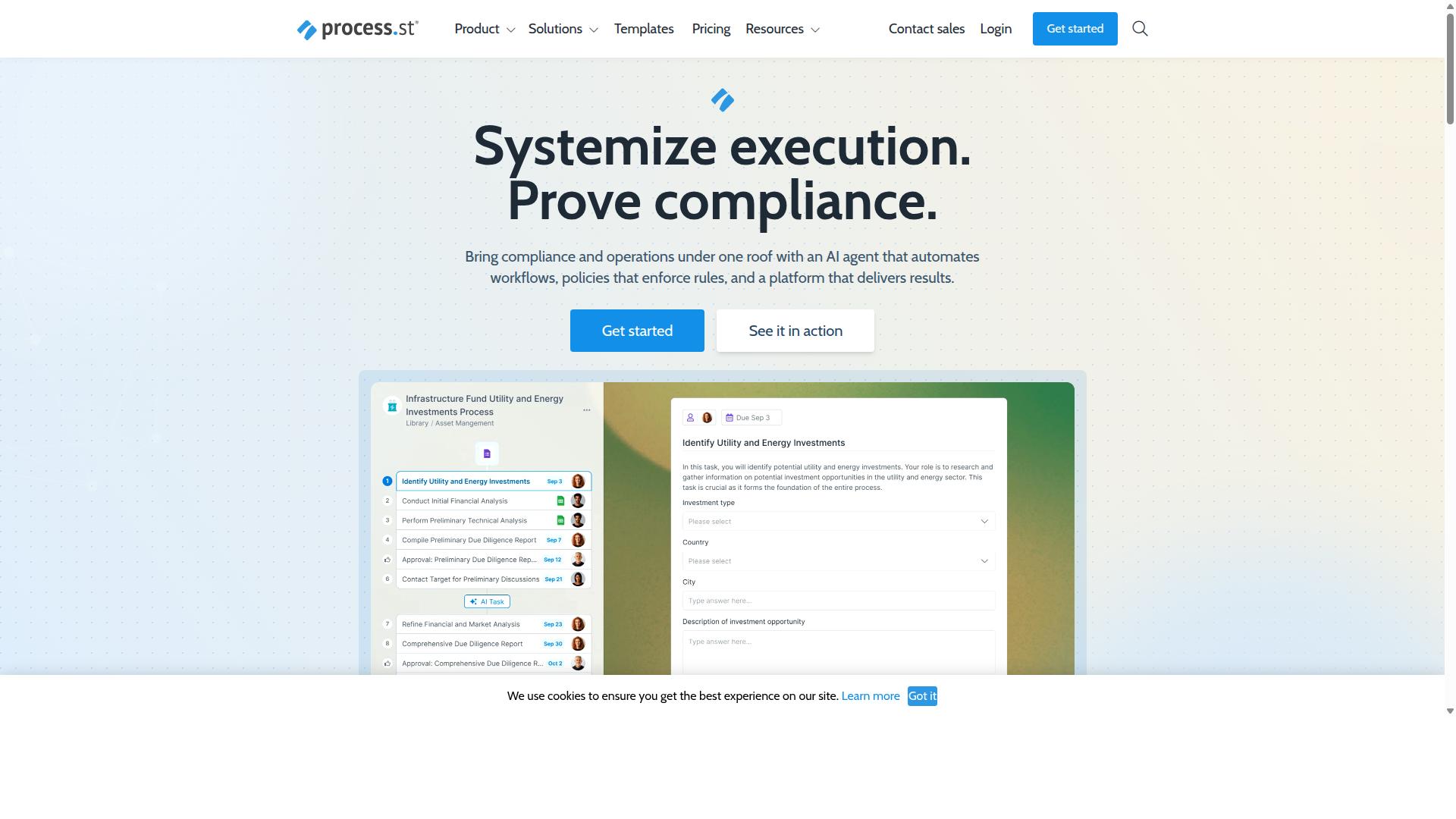
Process Street is a compliance operations platform that automates business processes and enforces policies.
The platform centers on three core products. Docs manages documents and policy control. Ops handles workflow automation and process orchestration. Cora serves as an AI compliance and risk agent.
Docs supports process standardization by maintaining controlled policy documents. This product keeps teams aligned on requirements and ensures consistent access to approved materials.
Ops drives workflow automation through structured process flows. Teams can orchestrate tasks, approvals, and sequences while maintaining visibility across operations.
Cora strengthens process compliance by monitoring risk factors. This AI agent helps organizations maintain audit-ready proof while supporting ongoing operational consistency.
Organizations use these three products together to standardize processes, prove compliance, and maintain consistency across industries. Each product addresses a different aspect of business process management while working within the same platform.
Why Process Street Excels at Visual Workflow Modeling
First sentence: Process Street's drag-and-drop interface turns complex workflows into clear, clickable diagrams without requiring coding skills.
Visual process builder tools let teams arrange steps, branches, and decision points on a single canvas. This approach helps users see how work moves from one person to the next.
Flowchart creation works best when paired with process hierarchy mapping. High-level steps live at the top layer. Each step can expand into detailed sub-processes below it.
Users can click any box to open its child steps. This keeps the main diagram clean while still showing full detail when needed.
Task dependencies appear as arrows that connect related items. When one task finishes, dependent tasks become active. Teams can spot delays before they grow.
Conditional logic paths let the diagram change based on answers or outcomes. If a request needs extra approval, the path branches right. If it passes review, it flows left. This keeps everyone on the correct route without manual checks.
Teams that need to update rules can edit the diagram once. The change takes effect across all active instances. This reduces errors and keeps process documentation current.
Clear visuals also support process standardization. New staff can follow the same diagram each time, which cuts training time and improves consistency across locations.
Key Features and What Makes Process Street Stand Out
Beyond the visual builder, Process Street packs features that turn static process maps into live, trackable workflows.
Process Street serves growing teams across regulated industries that need more than basic flowchart creation. Users start with a visual process builder that supports process mapping and drag-and-drop interface elements. After building the structure, they connect it to automation and compliance systems that keep work moving without manual handoffs.
This approach separates Process Street from generic BPM tools that stop at diagrams. Here, every workflow has an underlying engine that assigns tasks, triggers actions, and records proof for audits. The result is a single platform that handles process documentation, automation, and oversight in one place.
Ops: Workflow Automation and Process Orchestration
Ops converts policy documents into AI-driven workflows that assign tasks, enforce deadlines, and trigger escalations automatically.
The orchestration engine works through automation rules that respond to specific conditions. Users can set triggers based on task completion, form submissions, or time-based events. When a condition is met, the system can assign work, notify stakeholders, or move the process to the next stage without waiting for manual input.
Approval chains are handled through conditional logic that routes tasks to the right people based on the data entered. For example, a budget request above a certain amount can go to finance first, while smaller requests route directly to the manager. This setup uses task dependencies that prevent later steps from starting until earlier requirements are complete.
Teams on the Startup plan can run up to 100 automation actions per month. Higher tiers increase that limit while keeping the same rule builder. The approach turns documented processes into active systems that run consistently across the organization.
Cora: AI Compliance Agent for Real-Time Monitoring
Cora continuously scans active workflows against control frameworks such as ISO 9001, SOC 2, and SOX, highlighting deviations in real time.
The agent checks each running process against the rules defined in Docs. When a step is missed or a control fails, Cora flags the issue immediately instead of waiting for a scheduled audit. This workflow monitoring keeps teams aware of gaps before they become compliance problems.
Supported frameworks include ISO 9001, SOC 2, SOX, and FDA requirements. Cora maintains audit-ready proof by capturing every action, approval, and data point in the workflow. Teams no longer need to collect screenshots or chase email threads when auditors arrive.
Because the monitoring runs continuously, documentation time shrinks. The system generates the records automatically, so staff spend less time preparing evidence and more time on the actual work the process describes.
Pricing and Plans
Process Street offers three subscription tiers designed to scale with company size and automation volume.
The Startup plan serves growing teams with essential workflow needs. This tier supports up to 5 users and 10 guests. It includes 10 automation apps with 100 automation actions per month. Data Set records reach 5,000 entries.
Public API access stays limited to 50 calls monthly. The plan provides unlimited workflows and tasks for process documentation and visual workflow modeling.
The Pro plan expands capabilities for established teams. This subscription removes user and guest limits entirely. Data Set records increase to 10,000 entries.
Teams gain access to all automation apps with custom automation actions and API calls. This flexibility supports complex workflow automation and visual process builder requirements.
The Enterprise plan addresses large organizations with advanced needs. Custom Data Set records accommodate extensive process mapping projects. Unlimited Public API access enables seamless workflow automation across systems.
Enterprise customers receive a dedicated Success Manager along with priority support. The average support response time reaches five minutes across all plans. This rapid assistance ensures teams maintain process compliance and workflow monitoring without delays.
Additional enterprise features include fully-managed workflows, custom integrations, and bulk document import. Process consulting and health audits help organizations optimize their business process management strategies.
Trust Signals
Over 3,000 organizations and 1 million users rely on Process Street, with 49,000-plus employees standardized via its workflows. This established track record helps teams evaluate the platform for their workflow automation and visual workflow modeling needs.
Process Street holds SOC 2 Type II certification and maintains ISO 27001 compliance. These security standards address data protection requirements common in enterprise environments using business process management software.
IMCD UK reported a 75% reduction in setup time when implementing Process Street. The platform offers data-residency options across US, UK, Canada, EU, Australia, and UAE regions.
Additional compliance features include HIPAA with BAA availability, GDPR alignment, CCPA support, and AWS CIS certification. Process Street ensures data never trains AI models.
Who Should Use Process Street
Operations, compliance, HR, finance, and IT teams in financial services, healthcare, manufacturing, and professional services gain the most from Process Street. These groups benefit from clear workflow modeling that reduces confusion across complex business operations.
Financial services teams handle client onboarding through structured checklists. The platform supports real estate professionals managing property transfers and compliance documentation. Manufacturing operations rely on standardized processes for quality tracking and audit requirements.
Healthcare organizations need documented procedures for patient care protocols and regulatory compliance. Professional services firms use workflow templates to manage client deliverables and project milestones across multiple engagements.
Technology companies apply process mapping to software development cycles and deployment procedures. Capital markets teams track approval workflows for investment decisions. Property management groups coordinate maintenance requests and tenant communications through visual process builders.
Research suggests that organizations across these sectors achieve better process standardization when they adopt visual workflow modeling tools designed specifically for business process management needs.
Final Verdict
Process Street delivers an end-to-end solution for companies that need visual clarity, automated execution, and audit-ready proof. The platform combines workflow automation and process compliance into one system that keeps teams aligned and records complete. Organizations gain both speed and accountability without switching between disconnected tools.
Visual workflow modeling becomes a strength rather than a burden. Users map processes once, then run them repeatedly with consistent results. This approach reduces variation and builds a record that supports audits and reviews.
Support stays within reach through email and chat options. Teams receive responses in an average of five minutes, backed by a 98 percent customer rating. Contact sales directly when your team needs a walkthrough or deeper integration details.
Process Street is also available on AWS Marketplace. Interested parties can explore the listing, request a demo, and start conversations with the sales team from that single location. The combination of workflow automation, compliance focus, and responsive support positions the platform as a practical choice for teams that require both structure and visibility.
Recommended Resources: